| Melting Point | 163–165°C (lit.) |
| Color | White |
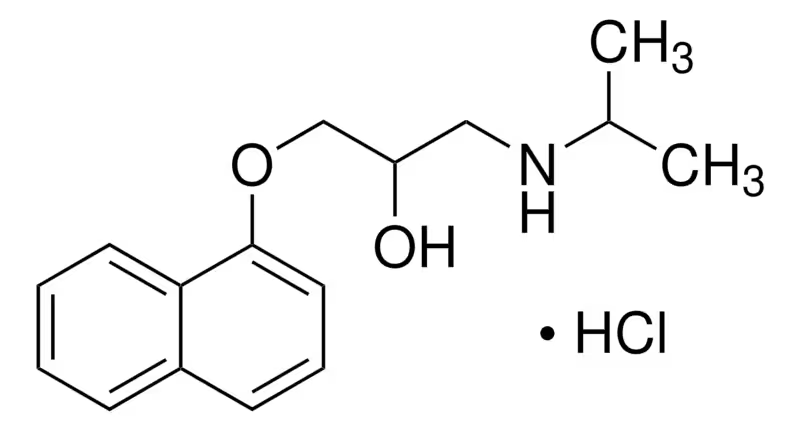
| Linear Formula | C10H7OCH2CH(OH)CH2NHCH(CH3)2·HCl |
| Formula Weight | 295.81 |
| Physical Form | Crystal-powder at 20°C |
| Chemical Name or Material | Propranolol hydrochloride |
| SMILES String | Cl[H].CC(C)NCC(O)COc1cccc2ccccc12 |
| Assay | 99% |
| CAS Number | 318-98-9 |
| EC Number | 206-268-7 |
| PubChem Substance ID | 329752297 |
| UNSPSC Code | 12352200 |
| MDL Number | MFCD00012558 |
| InChI | 1S/C16H21NO2.ClH/c1-12(2)17-10-14(18)11-19-16-9-5-7-13-6-3-4-8-15(13)16;/h3-9,12,14,17-18H,10-11H2,1-2H3;1H |
| InChI Key | ZMRUPTIKESYGQW-UHFFFAOYSA-N |
| PubChem CID | 62882 |
| Gene Information | Human: ADRB1 (153), ADRB2 (154) |
| Applications | Adrenergic receptor research: a reference antagonist for the human β1 (ADRB1) and β2 (ADRB2) adrenergic receptors in binding, signalling and cell-based assays. |
Propranolol hydrochloride is the salt of the aryloxypropanolamine propranolol with hydrochloric acid. Its formula is C16H21NO2·HCl and its molecular weight is 295.80 g/mol. The molecule consists of a naphthalene ring joined through an ether linkage to a 2-hydroxypropylamine chain that ends in an isopropylamino group. It contains one stereocentre and is sold as the racemate; the (S)-enantiomer carries most of the β-blocking activity.
Sigma-Aldrich lists the reference grade as a 99% solid melting at 163–165 °C and links it with the human genes ADRB1 and ADRB2, the two β-adrenergic receptor subtypes it antagonises. The listing classifies it as harmful if swallowed and as a non-combustible solid.
For pharmaceutical R&D teams, the compound is a convenient reference drug: it is stable, water-soluble and available in high purity, and decades of published data on its absorption, distribution, metabolism and receptor pharmacology allow new methods and delivery systems to be benchmarked against it. It is routinely used to qualify permeation cells, in-vitro dissolution apparatus and chromatographic systems.
For pharmacologists and cell biologists, it provides a pharmacologically defined β-blocker control. Researchers use it to separate β-adrenergic effects from other signalling pathways and to study downstream cyclic AMP responses.
Check the product name carefully: the correct spelling is propranolol (with an “r”), and “propanolol” is a common misspelling. Specify the salt form (hydrochloride, CAS 318-98-9) because the free base and the individual enantiomers have different CAS numbers. Store the powder tightly closed at room temperature, protected from light and moisture, away from strong oxidisers and alkaline materials, and confirm that your intended use is a lawful research or analytical use. Sarchem Labs supplies the material as a research chemical only.
Based on Sigma-Aldrich’s verified classification (222984).
Avoid ingestion and inhalation of dust. As a pharmacologically active compound, propranolol can lower heart rate and blood pressure, so prevent accidental exposure, keep the material away from food and drink, and dispose of waste through a licensed route.
No related products found.
It is used as a reference non-selective β-adrenergic antagonist in receptor and cell-signalling studies, as a model drug for dissolution, permeation and controlled-release experiments, and as a test compound in HPLC, LC-MS and chiral-separation method development.
No. Sarchem Labs supplies propranolol hydrochloride as a bulk research and analytical chemical. It is not a finished, approved drug product and is not intended for human or veterinary use.
Yes. "Propanolol" is a frequent misspelling of propranolol. The compound is propranolol hydrochloride, CAS 318-98-9, formula C16H21NO2·HCl.
The molecular weight is 295.80 g/mol and the literature melting point is 163–165 °C for the 99% reference grade.
Yes, the reference material is the racemate, (±)-propranolol hydrochloride. The individual (R)- and (S)-enantiomers are separate substances with their own CAS numbers.
Sigma-Aldrich classifies it as harmful if swallowed (H302, Acute Tox. 4 Oral), with the signal word Warning. Use an N95-type dust mask, eye protection and gloves.
Yes. Each lot of SKU S2702 includes a Certificate of Analysis and Safety Data Sheet, and Sarchem Labs quotes laboratory to bulk quantities for qualified research and industrial buyers.