| Melting Point | >300°C (lit.) |
| Color | White |
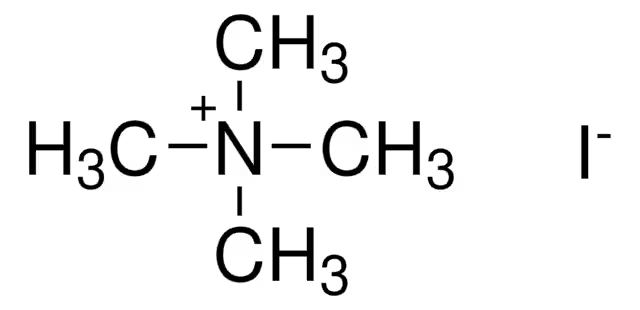
| Linear Formula | (CH3)4N(I) |
| Formula Weight | 201.05 |
| Physical Form | Crystal-Powder at 20°C |
| Chemical Name or Material | Tetramethylammonium Iodide |
| SMILES String | [I-].C[N+](C)(C)C |
| Assay | 99% |
| CAS Number | 75-58-1 |
| EC Number | 200-881-3 |
| NACRES | NA.22 |
| PubChem Substance ID | 24854126 |
| UNSPSC Code | 12352116 |
| MDL Number | MFCD00011629 |
| InChI | 1S/C4H12N.HI/c1-5(2,3)4;/h1-4H3;1H/q+1;/p-1 |
| InChI Key | RXMRGBVLCSYIBO-UHFFFAOYSA-M |
| PubChem CID | 6381 |
| Reaction Suitability | Core: ammonium; reaction type: phase-transfer; reagent type: organic catalyst |
| Beilstein/REAXYS Number | 3620030 |
| Quality Level | 100 |
| Form | Solid (crystal-powder at 20°C) |
| Applications | Phase-transfer catalysis: shuttles anions across aqueous–organic interfaces to speed up alkylations, substitutions and condensations in biphasic mixtures. |
Tetramethylammonium iodide is a quaternary ammonium salt with the formula (CH3)4N+ I−, a molecular weight of 201.05 g/mol and a melting point above 300 °C. The nitrogen carries four methyl groups and a permanent positive charge, so the cation cannot be deprotonated, which makes the salt stable in strongly basic as well as neutral media.
Sigma-Aldrich classifies the reference material under reaction type phase-transfer and reagent type organic catalyst, with an assay of 99% and a solid physical form. It is soluble in water and polar solvents and largely insoluble in non-polar organic solvents, which is why it is effective at ferrying small anions into mixed-phase reactions.
In synthetic chemistry, TMAI is employed where a small quaternary cation and a reactive iodide are wanted together. In phase-transfer reactions it speeds up substitution and alkylation steps under mild conditions, and in iodination procedures it provides the iodide that is oxidised in situ to the electrophilic iodinating species. Materials scientists use the tetramethylammonium cation as a template when growing zeolites and as a cation in hybrid halide crystals studied for optical and ferroelectric behaviour.
In analytical and electrochemical laboratories, TMAI is a clean electrolyte salt with a wide electrochemical window and a non-interfering cation, and it is also used as a standard in studies of ion transport.
Iodide salts can darken slowly in light and air as trace iodine forms, so store the material in tightly closed, opaque containers in a cool, dry place. Keep it away from strong oxidisers, which convert iodide to iodine, and from strong acids. The reference listing carries no GHS hazard classification, but tetramethylammonium salts are physiologically active quaternary ammoniums, and many suppliers’ safety data sheets for related tetramethylammonium compounds carry acute-toxicity warnings, so handle the material as toxic if swallowed and avoid dust.
Based on Sigma-Aldrich’s verified listing (235946).
As a precaution, treat the powder as harmful by ingestion and inhalation: weigh it in a ventilated enclosure, avoid dust, and wash hands after use. Dispose of waste through a licensed chemical-waste route.
No related products found.
It is used as a phase-transfer catalyst, as an iodide source for aromatic iodination, as a supporting electrolyte in electrochemistry, as a structure-directing cation in zeolite and hybrid-halide synthesis, and as a reagent in analytical chemistry.
The formula is (CH3)4N+ I− (written (CH3)4N(I)) and the molecular weight is 201.05 g/mol. The InChIKey is RXMRGBVLCSYIBO-UHFFFAOYSA-M.
The reference listing gives a melting point above 300 °C (literature value). The salt is thermally stable well beyond typical reaction temperatures.
Yes, it dissolves readily in water and other polar solvents, and it is only sparingly soluble in non-polar organic solvents, which is the property that makes it useful as a phase-transfer agent.
Store it tightly closed, protected from light, moisture and strong oxidisers, in a cool dry place. Light and air can slowly liberate iodine and tint the powder yellow.
The reference listing assigns no GHS classification, but it is a combustible solid (storage class 11) and quaternary ammonium salts of this type are often treated as toxic if swallowed. Use an N95-type dust mask, eyeshields and gloves.
Yes. Sarchem Labs provides a Certificate of Analysis and Safety Data Sheet with every lot of SKU S2192 and quotes bulk quantities on request.