| Density | 0.953 g/mL at 25°C |
| Color | Yellow |
| Linear Formula | [CH3(CH2)3]4NF |
| Formula Weight | 261.47 |
| Physical Form | Clear Liquid at 20°C |
| Chemical Name or Material | Tetrabutylammonium Fluoride (70-75% in Water) |
| UN Number | 1760 |
| SMILES String | [F-].CCCC[N+](CCCC)(CCCC)CCCC |
| Concentration | 70–75 wt. % in water |
| CAS Number | 429-41-4 |
| NACRES | NA.22 |
| PubChem Substance ID | 24862218 |
| UNSPSC Code | 12352116 |
| MDL Number | MFCD00011747 |
| InChI | 1S/C16H36N.FH/c1-5-9-13-17(14-10-6-2,15-11-7-3)16-12-8-4;/h5-16H2,1-4H3;1H/q+1;/p-1 |
| InChI Key | FPGGTKZVZWFYPV-UHFFFAOYSA-M |
| PubChem CID | 2724141 |
| Reaction Suitability | Core: ammonium; reaction type: phase-transfer |
| Beilstein/REAXYS Number | 3762762 |
| Quality Level | 100 |
| Functional Groups | Amine (quaternary ammonium) |
| Form | Viscous liquid |
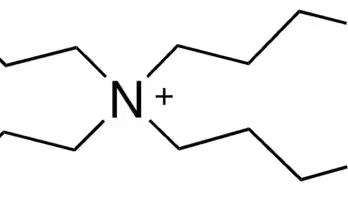
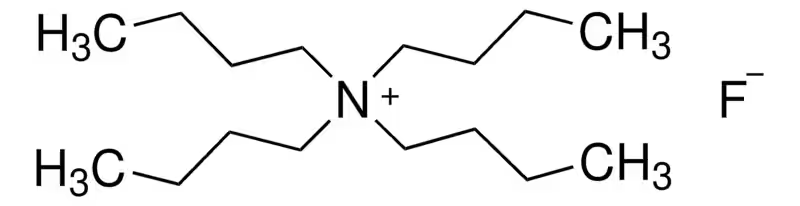
Tetrabutylammonium fluoride is the fluoride salt of the tetrabutylammonium cation, [CH3(CH2)3]4N+ F−, with a molecular weight of 261.46 g/mol for the anhydrous salt. The pure anhydrous salt is difficult to prepare and tends to decompose by Hofmann elimination, so TBAF is normally sold as a solution (for example 1.0 M in THF) or as a hydrate.
This listing is the concentrated aqueous solution, 70–75% by weight. In the reference form, 75 wt. % in water, the product is a viscous liquid with a density of 0.953 g/mL at 25 °C. Because fluoride in water is strongly hydrogen-bonded, the aqueous reagent is less nucleophilic than anhydrous TBAF, but it is fully adequate for silyl deprotection, where the high affinity of fluoride for silicon drives the reaction.
In synthetic chemistry, TBAF deprotection is usually carried out in THF at 0 °C to room temperature: the fluoride attacks silicon, forming a strong Si–F bond and releasing the alkoxide, which is protonated on work-up. For base-sensitive substrates, buffering with acetic acid prevents epimerisation or elimination.
In process chemistry and nucleic-acid chemistry, the solution is used for final deprotection steps, for phase-transfer reactions and as a fluoride activator for organosilicon cross-couplings. Its aqueous form is convenient when a measured amount of water is tolerated or even desired.
Choose the right form for the chemistry: for deprotections the aqueous solution is fine, while true anhydrous fluorination (SN2 or SNAr with fluoride) needs rigorously dry TBAF or a different fluoride source, because water suppresses nucleophilicity. The product is not the same as TBAF trihydrate or TBAF in THF, which are sold under different catalogue entries. Store tightly closed in a cool, well-ventilated place; the solution may darken on ageing, which does not usually affect deprotection performance. It ships under UN 1760 (corrosive liquid, n.o.s.), so store and handle it accordingly. Polyethylene or fluoropolymer containers are often preferred for long-term storage of fluoride solutions.
Based on Sigma-Aldrich’s verified classification for the 75 wt. % aqueous solution (361399).
Fluoride-containing solutions can be absorbed through the skin, so wear gloves and eye or face protection, work in a fume hood, rinse any skin or eye contact immediately and thoroughly, and follow your site’s fluoride first-aid plan. Never mix with acids.
No related products found.
TBAF is mainly used to remove silyl protecting groups from alcohols in organic synthesis, including in oligoribonucleotide synthesis. It is also used as a phase-transfer catalyst, as a mild base and as a fluoride activator in cross-coupling reactions.
TBAF stands for tetrabutylammonium fluoride (or tetra-n-butylammonium fluoride), [CH3(CH2)3]4NF, CAS 429-41-4.
No. This product is a 70–75% solution of TBAF in water. Anhydrous TBAF is unstable and is rarely sold; for dry fluorination chemistry use rigorously dried TBAF or an alternative fluoride source.
Generally no. Silyl-ether cleavage is driven by the strong silicon–fluorine bond, so aqueous TBAF is widely used for TBS, TIPS and TES deprotections. Water does reduce fluoride's nucleophilicity for substitution reactions.
It is a yellow, viscous liquid with a density of 0.953 g/mL at 25 °C. The molecular weight of the anhydrous salt is 261.46 g/mol.
Yes. Sigma-Aldrich classifies the aqueous solution as harmful if swallowed (H302), a skin and eye irritant (H315, H319), suspected of damaging fertility and the unborn child (H361fd) and harmful to aquatic life (H412). Contact with acids liberates very toxic gas (EUH032).
Yes. The Certificate of Analysis and Safety Data Sheet for each lot of SKU S2720 are provided with the shipment, and bulk quantities can be quoted on request.