| Melting Point | 316.5°C |
| Chemical Name or Material | Quercetin (anhydrous) |
| Molecular Weight | 302.24 g/mol |
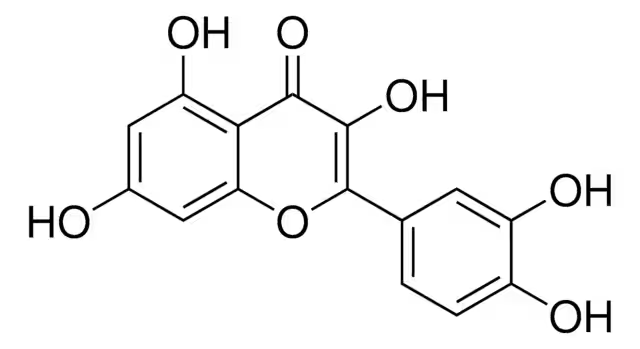
| SMILES String | OC1=CC(O)=C2C(OC(C3=CC=C(O)C(O)=C3)=C(O)C2=O)=C1 |
| Assay | ≥95% (HPLC) |
| Solubility | Practically insoluble in water |
| CAS Number | 117-39-5 |
| Storage Temperature | Room temperature |
| EC Number | 204-187-1 |
| NACRES | NA.77 |
| PubChem Substance ID | 329823865 |
| UNSPSC Code | 12352207 |
| InChI | 1S/C15H10O7/c16-7-4-10(19)12-11(5-7)22-15(14(21)13(12)20)6-1-2-8(17)9(18)3-6/h1-5,16-19,21H |
| InChI Key | REFJWTPEDVJJIY-UHFFFAOYSA-N |
| PubChem CID | 5280343 |
| Beilstein/REAXYS Number | 317313 |
| Quality Level | 100 |
| Form | Solid |
| Empirical Formula (Hill Notation) | C15H10O7 |
Quercetin is a flavonol: a 15-carbon C6–C3–C6 skeleton in which a benzopyranone core carries a 3,4-dihydroxyphenyl ring and hydroxyl groups at positions 3, 5 and 7. The anhydrous compound has the formula C15H10O7 (302.24 g/mol, CAS 117-39-5). Quercetin also exists as a hydrate and a dihydrate, which carry different CAS numbers and molecular weights, so state the form when you order and calculate concentrations from the molecular weight on the Certificate of Analysis.
Intramolecular hydrogen bonding makes the molecule planar and rather insoluble in water, while the conjugated chromophore gives the yellow colour and strong UV absorption used in HPLC detection.
In analytical chemistry, quercetin is the first compound many laboratories use to establish flavonoid methods. Its retention behaviour, UV spectrum and mass spectrum anchor the identification of related flavonols such as kaempferol, myricetin and isorhamnetin, and of quercetin glycosides such as rutin after hydrolysis.
In research, quercetin is used as a polyphenol benchmark in antioxidant assays, as a model ligand for metal-chelation work and as a reference flavonoid in enzyme and cell-signalling studies. In synthetic chemistry, selective protection, alkylation or glycosylation of its hydroxyl groups gives a large family of derivatives.
Check that the assay (≥95% by HPLC), the form (anhydrous versus hydrate) and the water content on the Certificate of Analysis suit your method. The powder is light- and air-sensitive over time, so keep it tightly closed, protected from light, in a cool, dry place at room temperature. Dissolve in DMSO or ethanol for stock solutions, because water solubility is very low. Sarchem Labs supplies the material as a chemical reagent, not as a dietary supplement.
Do not eat, drink or smoke when using the product, avoid dust and wash hands thoroughly after handling.
No related products found.
It is used as a reference standard for flavonoid analysis by HPLC and LC-MS, as a benchmark polyphenol in antioxidant and metal-chelation studies, as a scaffold in kinase-inhibitor research and as a starting material for semi-synthetic derivatives.
The anhydrous form (CAS 117-39-5) has a molecular weight of 302.24 g/mol, while the dihydrate carries two molecules of water of crystallisation and has a higher molecular weight and its own CAS number. Use the molecular weight of the exact form when preparing solutions.
The formula is C15H10O7, the molecular weight is 302.24 g/mol and the melting point is about 316 °C. The reference assay is at least 95% by HPLC.
No, it is practically insoluble in water. Prepare stock solutions in DMSO or ethanol and dilute into aqueous buffers just before use.
It is classified as toxic if swallowed (H301), a skin irritant (H315) and a serious eye irritant (H319). Wear gloves, eye protection and a dust mask and avoid creating dust.
Store it tightly closed in a cool, dry place at room temperature, protected from light and from strong oxidisers.
Yes. The Certificate of Analysis and Safety Data Sheet for each lot of SKU S2083 are provided with the shipment, and bulk quantities can be quoted on request.