

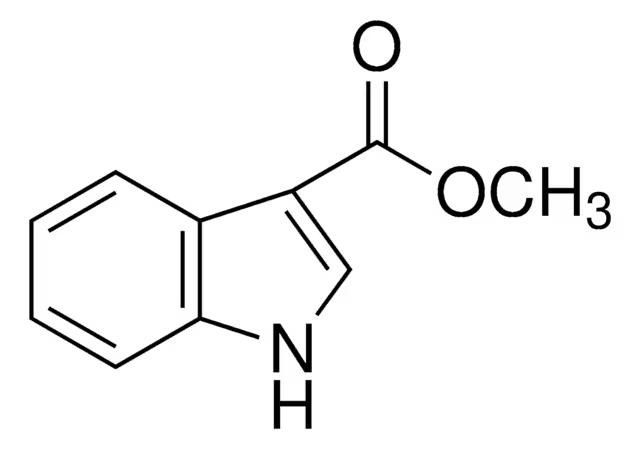
| Melting Point | 149–152°C (lit.) |
| Chemical Name or Material | Methyl 1H-indole-3-carboxylate |
| Molecular Weight | 175.18 g/mol |
| SMILES String | COC(=O)c1c[nH]c2ccccc12 |
| Assay | 99% |
| CAS Number | 942-24-5 |
| NACRES | NA.22 |
| PubChem Substance ID | 24864651 |
| UNSPSC Code | 12352100 |
| MDL Number | MFCD00189407 |
| InChI | 1S/C10H9NO2/c1-13-10(12)8-6-11-9-5-3-2-4-7(8)9/h2-6,11H,1H3 |
| InChI Key | QXAUTQFAWKKNLM-UHFFFAOYSA-N |
| PubChem CID | 589098 |
| Functional Groups | Ester |
| Form | Powder |
| Empirical Formula (Hill Notation) | C10H9NO2 |
Methyl indole-3-carboxylate is an indole whose C3 position carries a methoxycarbonyl group, with the N–H free. The formula is C10H9NO2 and the molecular weight is 175.18 g/mol. The electron-withdrawing ester at C3 lowers the nucleophilicity of the pyrrole ring relative to indole, which directs electrophilic substitution to the benzene ring; hence bromination takes place at C5 and C6. The N–H is acidic enough to be alkylated or acylated with a base, and the ester can be hydrolysed, reduced or converted to the amide. It is a different compound from indole-3-carboxylic acid (the free acid), methyl indole-2-carboxylate and indole-3-carbaldehyde.
Medicinal chemists use the ester as an entry point to 3-substituted indoles: N-alkylation and ring halogenation first, then hydrolysis to the acid or aminolysis to indole-3-carboxamides, which are common in kinase, polymerase and nitric oxide synthase inhibitor programmes. Natural-product chemists use it as a reference compound and as a starting material for brominated indole alkaloid analogues.
The assay shown is 99%. Ask for the Certificate of Analysis of the lot, and tell us if you need the 5- or 6-substituted analogues, which are separate products. Store in a tightly closed container in a cool, dry place away from strong oxidisers, strong bases and light, because indoles can darken on prolonged exposure to air and light. Use gloves, eye protection and a dust mask when weighing.
Although no hazard classification is published, handle it as a fine organic powder: avoid generating dust, avoid contact with eyes and skin, and wash hands after use.
No related products found.
It is used as a building block for indole-based inhibitors of neuronal nitric oxide synthase, PKCα and the C-terminal domain of RNA polymerase II, and as a precursor of brominated indoles.
No. Methyl indole-3-carboxylate (CAS 942-24-5) is the methyl ester. Indole-3-carboxylic acid is the free acid and has a different CAS number, melting point and reactivity.
The formula is C10H9NO2, the molecular weight is 175.18 g/mol and the melting point is 149–152 °C. The assay is 99%.
With bromine in acetic acid the dibromination is regioselective and gives methyl 5,6-dibromoindole-3-carboxylate, because the ester deactivates the pyrrole ring.
No hazard classification is published. Handle it as a fine organic powder, with gloves, eye protection and a dust mask.
Keep it tightly closed in a cool, dry place, away from light, strong oxidisers and strong bases.
Yes. SKU S1745 is supplied with a lot-specific Certificate of Analysis and Safety Data Sheet, and Sarchem Labs provides quotes from laboratory packs to bulk volumes.



