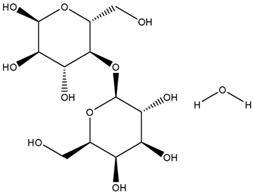
PubChem CID 133126686 – d-Lactose monohydrate (also known as d-+-lactose monohydrate).
| Appearance | Pass Test |
| Melting Point | 219°C |
| Vapor Pressure | Negligible |
| Density | 1.525g/cm³ |
| Color | White |
| Packaging | Fiber Drum |
| Formula Weight | 360.32 |
| Physical Form | Solid |
| Chemical Name or Material | D-Lactose Monohydrate |
| Alpha Vector | Lactose Monohydrate |
| Acidity | Pass Test |
| Decomposition Information | >219°C |
| Ignition Residue | 0.1% max. |
| Loss on Drying | 0.5% max. |
| Identification | Pass Test |
| Specific Rotation | 54.4 to 55.9° (+ or -) |
| Residual Solvents | Meets Requirements |
| Grade | NF |
| Water | 4.5 to 5.5% |
Classification of the substance or mixture
GHS Label elements, including precautionary statements
Hazards not otherwise classified (HNOC) or not covered by GHS
GHS Classification in accordance with 29 CFR 1910 (OSHA HCS). For the full text of the H-Statements mentioned in this Section, see Section 16.
Signal word :
"Sarchem Labs provides top-quality chemicals that meet the highest industry standards. Their reliable supply chain, excellent purity levels, and prompt customer service make them our go-to partner for research and production needs."
"We trust Sarchem Labs for their high-purity reagents and chemicals. Their extensive product catalog and fast shipping ensure that we always have what we need for our laboratory experiments without delays."
"Sarchem Labs stands out for its commitment to quality, safety, and customer satisfaction. Their chemicals are consistently reliable, and their support team is always ready to assist with any inquiries. Highly recommended!"
Lactose monohydrate decomposes rather than melting, typically at around 202°C. It loses its water of crystallization before breaking down, which distinguishes it from anhydrous lactose.
Lactose monohydrate is widely used as a pharmaceutical excipient, especially in tablets and capsules, and also serves as a filler, stabilizer, and sweetener in food and dietary supplements.
Lactose monohydrate consists of a galactose and glucose unit linked by a β-1,4-glycosidic bond, plus one water molecule per lactose molecule in its crystalline structure.
Lactose monohydrate is a white, crystalline powder, slightly sweet, stable under dry conditions, and sparingly soluble in water. It’s also non-hygroscopic and compatible with many active pharmaceutical ingredients.
Its compressibility, stability, and flowability make lactose monohydrate ideal for direct compression and wet granulation processes in tablet formulations, ensuring consistent dosage and reliable performance.