| Melting Point | 180–187°C (lit.) |
| Color | White |
| Formula Weight | 387.44 |
| Physical Form | Crystal-powder at 20°C |
| Chemical Name or Material | N-[(9H-Fluoren-9-ylmethoxy)carbonyl]-L-phenylalanine |
| Molecular Weight | 387.43 g/mol |
| SMILES String | OC(=O)[C@H](Cc1ccccc1)NC(=O)OCC2c3ccccc3-c4ccccc24 |
| Assay | 98% |
| CAS Number | 35661-40-6 |
| Storage Temperature | 2–8°C |
| EC Number | 252-661-1 |
| NACRES | NA.26 |
| PubChem Substance ID | 24860536 |
| UNSPSC Code | 12352209 |
| MDL Number | MFCD00037128 |
| InChI | 1S/C24H21NO4/c26-23(27)22(14-16-8-2-1-3-9-16)25-24(28)29-15-21-19-12-6-4-10-17(19)18-11-5-7-13-20(18)21/h1-13,21-22H,14-15H2,(H,25,28)(H,26,27)/t22-/m0/s1 |
| InChI Key | SJVFAHZPLIXNDH-QFIPXVFZSA-N |
| PubChem CID | 978331 |
| eCl@ss | 32160406 |
| Reaction Suitability | Reaction type: C–H activation; Fmoc solid-phase peptide synthesis; peptide synthesis; reagent type: ligand |
| Beilstein/REAXYS Number | 3597808 |
| Quality Level | 200 |
| Optical Activity | [α]20/D −37°, c = 1 in DMF |
| Functional Groups | Fmoc, amine, carboxylic acid |
| Empirical Formula (Hill Notation) | C24H21NO4 |
| Application | Peptide synthesis |
| Applications | Fmoc solid-phase peptide synthesis: installs L-phenylalanine residues in research peptides, peptide libraries, epitope mimics and therapeutic peptide candidates. |
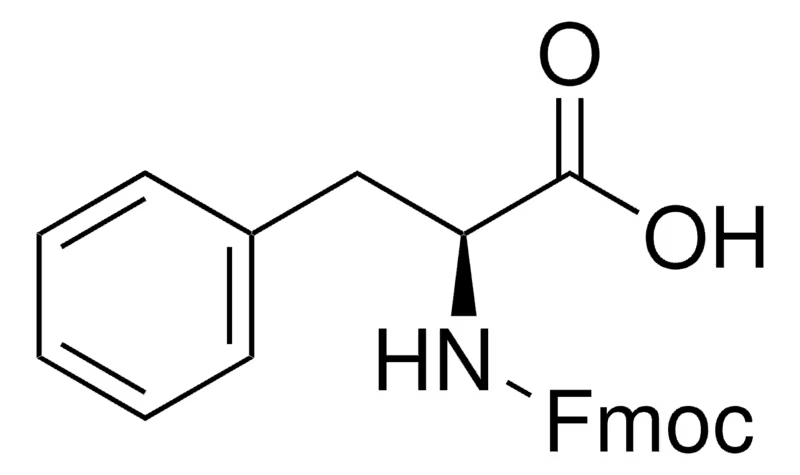
Fmoc-Phe-OH is L-phenylalanine whose α-amino group has been converted to a 9-fluorenylmethyl carbamate. It has the formula C24H21NO4 and a molecular weight of 387.43 g/mol. The free carboxylic acid is the coupling site: activated with a carbodiimide, uronium or phosphonium reagent, it forms an amide bond with the amine of the growing peptide chain.
The fluorenyl ring system is both UV-active, which allows deprotection to be monitored at about 300 nm, and base-labile, because piperidine abstracts the acidic proton at C-9 and triggers elimination of dibenzofulvene. Sigma-Aldrich lists the reference grade at 98% with a specific rotation of −37° in DMF and a recommended storage temperature of 2–8 °C.
In peptide laboratories, it is used wherever a sequence contains phenylalanine, which includes most opioid peptides, many hormone analogues, antimicrobial peptides and numerous protease-substrate sequences. Chemists couple it with reagents such as DIC/Oxyma, HBTU or HATU in DMF or NMP, remove the Fmoc group with piperidine, and repeat the cycle until the peptide is complete.
In the pharmaceutical supply chain, it is a high-volume raw material for peptide drugs, where lot-to-lot purity and low levels of dipeptide or free amino acid impurities matter. Materials scientists use the same compound to form Fmoc-based supramolecular gels, and organometallic chemists use protected amino acids of this family as ligands.
For SPPS, three quality attributes matter most: HPLC purity, enantiomeric purity and free-amino-acid content. Free amino acid can cause double insertions, and D-isomer contamination produces diastereomeric peptide impurities that are hard to remove. Request the lot-specific values from the Certificate of Analysis. Store at 2–8 °C in a tightly closed container, protect from moisture, and allow the bottle to reach room temperature before opening so that water does not condense on the powder.
Based on Sigma-Aldrich’s verified listing (338338).
Handle as a fine organic powder: weigh in a ventilated enclosure, avoid dust formation and inhalation, and keep away from sources of ignition. Piperidine and DMF used with this reagent have their own hazards and require separate review.
No related products found.
It is used to add L-phenylalanine residues during Fmoc solid-phase peptide synthesis. It is a standard raw material for research peptides, peptide libraries and peptide drug candidates, and it is also studied for self-assembling hydrogels and as a ligand in palladium-catalysed C–H activation.
Fmoc stands for 9-fluorenylmethoxycarbonyl, an amine-protecting group that is stable to acids but removed by mild bases such as 20% piperidine in DMF. That makes it compatible with acid-labile side-chain protecting groups.
The formula is C24H21NO4 and the molecular weight is 387.43 g/mol. The reference grade has a melting range of 180–187 °C and a specific rotation of −37° (c = 1 in DMF).
Yes. Fmoc-Phe-OH, Fmoc-L-phenylalanine and N-Fmoc-L-phenylalanine are the same compound, CAS 35661-40-6. The D-enantiomer, Fmoc-D-Phe-OH, has a different CAS number and should not be substituted.
Store it at 2–8 °C in a tightly closed container, away from moisture, light and strong bases. Let the container warm to room temperature before opening to avoid condensation.
The reference listing assigns no GHS hazard statement. It is a combustible solid (storage class 11), so use an N95-type dust mask, eyeshields and gloves and prevent dust accumulation.
Yes. Each lot of SKU S2329 ships with a Certificate of Analysis and Safety Data Sheet, and Sarchem Labs quotes laboratory to bulk quantities.