| Melting Point | 34–38°C (lit.) |
| Formula Weight | 185.22 |
| percent purity | 97% |
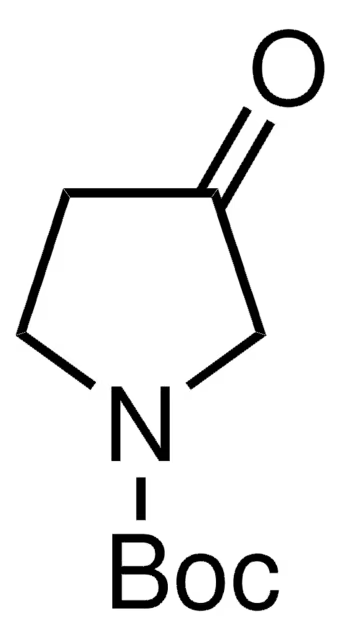
| Chemical Name or Material | tert-Butyl 3-oxopyrrolidine-1-carboxylate |
| Molecular Weight | 185.22 g/mol |
| SMILES String | CC(C)(C)OC(=O)N1CCC(=O)C1 |
| Solubility Information | Insoluble in water. |
| Assay | 97% |
| Solubility | Insoluble in water |
| CAS Number | 101385-93-7 |
| Storage Temperature | −20°C |
| NACRES | NA.22 |
| PubChem Substance ID | 24882865 |
| UNSPSC Code | 12352100 |
| MDL Number | MFCD01631194 |
| InChI | 1S/C9H15NO3/c1-9(2,3)13-8(12)10-5-4-7(11)6-10/h4-6H2,1-3H3 |
| InChI Key | JSOMVCDXPUXKIC-UHFFFAOYSA-N |
| PubChem CID | 471360 |
| Quality Level | 100 |
| Functional Groups | Ketone |
| Form | Solid (low-melting) |
| Empirical Formula (Hill Notation) | C9H15NO3 |
N-Boc-3-pyrrolidinone is a five-membered cyclic β-amino ketone: the nitrogen (as a Boc carbamate) and the carbonyl carbon are separated by one methylene group. The formula is C9H15NO3 and the molecular weight is 185.22 g/mol. The Boc group is stable to bases, nucleophiles and hydride reductions, so the ketone can be transformed selectively, and it is removed with trifluoroacetic acid or HCl when the free pyrrolidine nitrogen is needed. The α-methylene groups are enolisable, so the ketone can also be alkylated or brominated under standard conditions.
It is a different compound from N-Boc-3-pyrrolidinol (the alcohol) and N-Boc-2-pyrrolidinone (the lactam), which have different CAS numbers and reactivity.
The compound is a workhorse in medicinal chemistry because the pyrrolidine ring is one of the most frequent saturated N-heterocycles in drugs, and C3 substitution is how the ring is tuned for potency and selectivity. Typical sequences are reductive amination followed by Boc removal and amide coupling, Grignard addition followed by deoxygenation, or bioreduction to a chiral alcohol followed by Mitsunobu inversion or alkylation.
The grade offered is 97% assay. Ask for the Certificate of Analysis of the lot, and for the enantiomeric-excess data if you also order the chiral alcohol products. Keep the container tightly closed and frozen at −20 °C; the low melting point means the material may soften or fuse in warm conditions, so equilibrate the closed container to room temperature before opening to avoid moisture condensation. Avoid contact with acids, which remove the Boc group. The powder can cause serious eye damage.
Causes serious eye damage: wear eye and face protection, avoid dust, and in case of eye contact rinse cautiously with water for several minutes and obtain medical attention.
No related products found.
It is used as a protected pyrrolidinone building block for 3-aminopyrrolidines (reductive amination), 3-substituted 3-hydroxypyrrolidines (Grignard additions), chiral 3-hydroxypyrrolidines (asymmetric reduction) and spirocyclic compounds.
Yes. N-Boc-3-pyrrolidinone, 1-Boc-3-pyrrolidinone and tert-butyl 3-oxopyrrolidine-1-carboxylate are the same compound, CAS 101385-93-7.
The formula is C9H15NO3, the molecular weight is 185.22 g/mol and the melting point is 34–38 °C. The assay is 97%.
Store it tightly closed at −20 °C. Let the closed container warm to room temperature before opening to avoid condensation, and keep it away from acids.
With trifluoroacetic acid in dichloromethane or HCl in dioxane at room temperature, which releases isobutylene and carbon dioxide.
It is harmful if swallowed (H302), irritates the skin and airways (H315, H335) and causes serious eye damage (H318), with the signal word Danger. Wear eye and face protection, gloves and a dust mask.
Yes. Every lot of SKU S1148 includes a Certificate of Analysis and Safety Data Sheet, and Sarchem Labs can quote laboratory, pilot and bulk quantities.