| Melting Point | 200°C |
| Color | White |
| Formula Weight | 347.22 |
| Physical Form | Crystal-Powder at 20°C |
| Chemical Name or Material | 5′-Adenylic acid |
| Molecular Weight | 347.22 g/mol (anhydrous) |
| SMILES String | O[C@H]1[C@@H](O)[C@H](N(C=N2)C3=C2C(N)=NC=N3)O[C@@H]1COP(O)(O)=O |
| Solubility | 1 M NH4OH: 50 mg/mL, clear and colourless; water: soluble with addition of mild alkali |
| CAS Number | 61-19-8 |
| Storage Temperature | −20°C |
| Empirical Formula | C10H14N5O7P |
| NACRES | NA.51 |
| UNSPSC Code | 41106305 |
| InChI | 1S/C10H14N5O7P/c11-8-5-9(13-2-12-8)15(3-14-5)10-7(17)6(16)4(22-10)1-21-23(18,19)20/h2-4,6-7,10,16-17H,1H2,(H2,11,12,13)(H2,18,19,20)/t4-,6-,7-,10-/m1/s1 |
| InChI Key | UDMBCSSLTHHNCD-KQYNXXCUSA-N |
| PubChem CID | 6083 |
| eCl@ss | 32160414 |
| Form | Solid (crystal-powder at 20°C) |
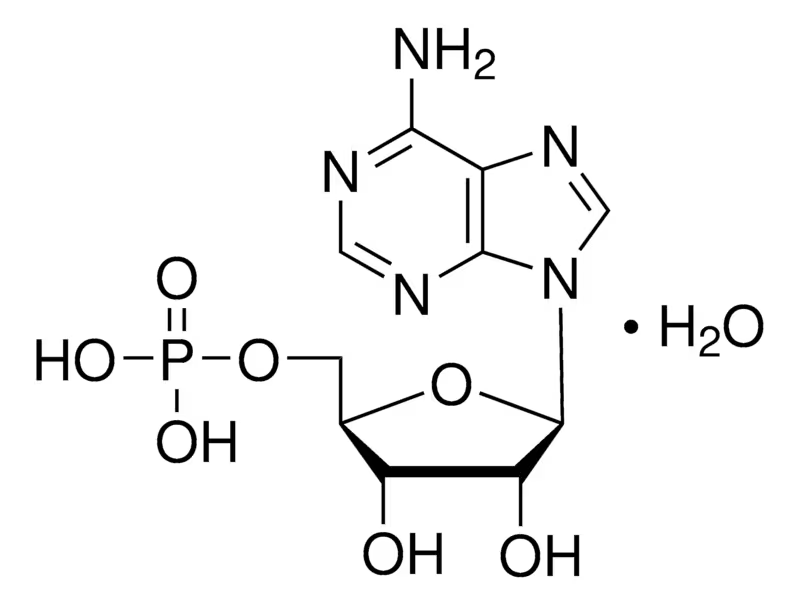
| Related Form (Monohydrate) | CAS 18422-05-4; C10H14N5O7P · H2O; 365.24 g/mol |
| PubChem Substance ID (monohydrate) | 24890637 |
| Beilstein/REAXYS Number (monohydrate) | 54612 |
| MDL Number (monohydrate) | MFCD00149360 |
Adenosine 5′-monophosphate is a ribonucleotide: adenine joined through an N9-glycosidic bond to D-ribose, which carries one phosphate group on its 5′-hydroxyl. The formula is C10H14N5O7P and the molecular weight is 347.22 g/mol (365.24 g/mol as the monohydrate, CAS 18422-05-4). It should not be confused with the 2′- and 3′-monophosphate isomers, which carry the phosphate on a different ribose hydroxyl, or with cyclic AMP (cAMP), in which the phosphate forms a ring between the 3′ and 5′ positions, or with ADP and ATP, which carry two and three phosphate groups.
Sigma-Aldrich’s reference grade is the monohydrate at ≥97% purity, stored at −20 °C; it dissolves in 1 M ammonium hydroxide at 50 mg/mL and in water once mild alkali is added.
AMP is the molecule through which cells read their energy state. When ATP is consumed and the AMP:ATP ratio rises, AMP binds AMPK and activates it, switching on catabolic pathways such as glucose uptake and fatty-acid oxidation and switching off energy-consuming biosynthesis. That makes AMP and its analogues central reagents in diabetes, obesity, cancer-metabolism and exercise-physiology research.
Biochemists also use AMP as a substrate and effector in enzyme studies (phosphorylase b, adenylate kinase, AMP deaminase), as a starting material for ADP, ATP and nucleotide-analogue synthesis, and as an HPLC standard for adenylate-energy-charge measurements.
Because AMP exists as the anhydrous acid, a hydrate and several salts with different molecular weights, state the form when you order and calculate molarity from the formula weight on the Certificate of Analysis. Protect the solid from moisture and store it at −20 °C in a tightly closed container, allowing it to warm to room temperature before opening. Nucleotides hydrolyse slowly in solution, so prepare solutions fresh or freeze small aliquots. Solutions of the free acid are acidic; dissolve with a little dilute base such as ammonium or sodium hydroxide and adjust the pH to the assay buffer.
Based on Sigma-Aldrich’s verified listing (A2252).
Handle with standard laboratory precautions: avoid generating dust, avoid contact with eyes and skin, wear gloves and safety glasses, and wash hands after use.
No related products found.
It is used in AMPK and other kinase assays, as a substrate or effector in enzymology, as a starting material for ADP, ATP and nucleotide-analogue synthesis, in NAD+ metabolism research and as an HPLC standard for adenine nucleotides.
AMP carries one phosphate group on the 5′-hydroxyl of adenosine, ADP carries two and ATP carries three. Cyclic AMP (cAMP) has its single phosphate closed into a ring between the 3′ and 5′ positions and acts as a second messenger.
AMP binds the regulatory γ-subunit of AMPK, which promotes phosphorylation of AMPK by upstream kinases and inhibits its dephosphorylation. Active AMPK then switches on energy-producing pathways and switches off energy-consuming ones.
The anhydrous free acid is C10H14N5O7P with a molecular weight of 347.22 g/mol. The monohydrate (CAS 18422-05-4) has a molecular weight of 365.24 g/mol, and salt forms differ again.
Dissolve it in water with a small amount of mild alkali, such as dilute ammonium or sodium hydroxide. Sigma-Aldrich lists water solubility on addition of mild alkali and reports 50 mg/mL in 1 M ammonium hydroxide as a clear, colourless solution.
Store the solid at −20 °C, tightly closed and protected from moisture. Make solutions fresh or freeze aliquots, because nucleotides hydrolyse slowly in solution.
Yes. SKU S3481 is supplied with a lot-specific Certificate of Analysis and Safety Data Sheet, and Sarchem Labs provides quotes from laboratory packs to bulk volumes.