| Appearance | Colourless to light orange-yellow, clear liquid |
| Melting Point | ~27 °C (estimated) |
| pH of Liquid, Typical (10% soln) | Not typically specified (not a standard aqueous specification) |
| Specific Gravity Approx | ~1.03 g/mL at 20 °C |
| Odor | Characteristic organic acid/chemical odor (not usually specified) |
| Color | Colourless to yellow |
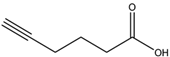
| Linear Formula | CH≡C(CH₂)₃COOH |
| IUPAC Name | hex-5-ynoic acid |
| Formula Weight | 112.13 g/mol |
| percent purity | Typically ≥ 96 % (often ~97 %) |
| Physical Form | Liquid |
| Chemical Name or Material | 5-Hexynoic acid (alkynoic acid intermediate) |
| Content / Assay Percent Range | ≥ 96 % (GC) typical specification |
| 143036 |
5-Hexynoic Acid is an aliphatic carboxylic acid containing a terminal alkyne group. It is commonly used as an intermediate in organic and chemical synthesis, particularly in reactions involving alkyne functionalization and carbon–carbon bond formation. The compound is valued in research and industrial settings for developing speciality chemicals and advanced molecular frameworks.
Synonym: 5-hexynoic acid, 5-hexyn-1-oic acid, 4-ethynylbutyric acid, acmc-1an4h
No related products found.
Hexynoic acid is a six-carbon unsaturated carboxylic acid containing a terminal alkyne group. It is commonly used as a synthetic intermediate in organic chemistry and materials science applications.
Hexynoic acid features a carboxylic acid group (–COOH) attached to a linear carbon chain with a triple bond. Its molecular formula is C6H8O2, and it contains both polar and unsaturated regions.
Hexynoic acid is a colourless to pale yellow liquid with a sharp odour. It is slightly soluble in water, highly reactive due to the alkyne group, and has moderate acidity.
Hexynoic acid is used in chemical synthesis, especially for creating polymers, pharmaceuticals, and speciality chemicals. Its terminal alkyne group allows for click chemistry and other functionalization reactions.
The terminal alkyne in Hexynoic acid is highly reactive, enabling a wide range of organic reactions such as coupling, cycloadditions, and functional group transformations in advanced chemical synthesis.