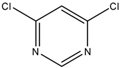
Short description: PubChem CID 70943 – 4,6-Dichloropyrimidine (also known as 4,6-dichloro-pyrimidine, 4,6-dichloro-1,3-diazine, dichloropyrimidine, ZLChem 225, PubChem6913)
| Boiling Point | 176°C |
| Melting Point | 64°C to 68°C |
| Formula Weight | 148.98 |
| Chemical Name or Material | 4,6-Dichloropyrimidine |
| UN Number | UN3261 |
| Beilstein | 111195 |
Classification of the substance or mixture
GHS Label elements, including precautionary statements
Hazards not otherwise classified (HNOC) or not covered by GHS
Â
"Sarchem Labs provides top-quality chemicals that meet the highest industry standards. Their reliable supply chain, excellent purity levels, and prompt customer service make them our go-to partner for research and production needs."
"We trust Sarchem Labs for their high-purity reagents and chemicals. Their extensive product catalog and fast shipping ensure that we always have what we need for our laboratory experiments without delays."
"Sarchem Labs stands out for its commitment to quality, safety, and customer satisfaction. Their chemicals are consistently reliable, and their support team is always ready to assist with any inquiries. Highly recommended!"
The chemical formula of dichloropyrimidine is C4H2Cl2N2. It consists of four carbon atoms, two hydrogen atoms, two chlorine atoms, and two nitrogen atoms arranged in a six-membered heterocyclic ring.
Dichloropyrimidine is a pale to yellow crystalline compound, slightly soluble in water but soluble in organic solvents. It exhibits high chemical reactivity due to electron-deficient carbon atoms adjacent to the chlorine atoms.
The melting point of dichloropyrimidine varies by isomer, but it typically lies between 60°C and 90°C. Purity and positional isomerism may influence this thermal property.
Dichloropyrimidine generally has a boiling point in the range of 220°C to 240°C, depending on the specific isomer and atmospheric pressure. It should be heated with care in controlled conditions.
Dichloropyrimidine serves as an essential intermediate in pharmaceutical, agrochemical, and fine chemical industries. Its reactive chlorinated pyrimidine ring is ideal for nucleophilic substitution reactions in complex molecule formation.