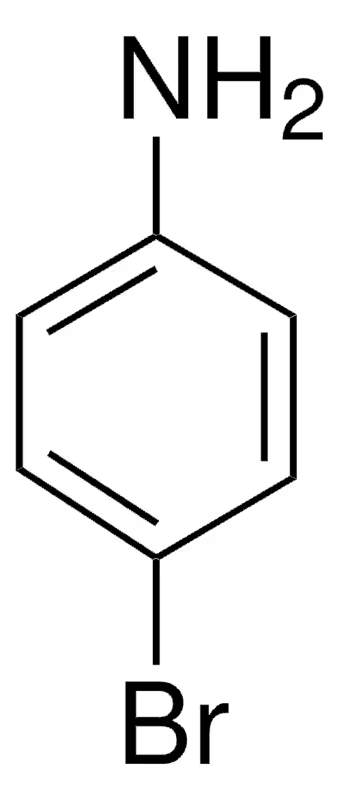
| Boiling Point | 124°C |
| Melting Point | 56–65°C (lit.) |
| Color | White to yellow |
| Linear Formula | BrC6H4NH2 |
| Formula Weight | 172.03 |
| Physical Form | Crystal-Powder at 20°C |
| Chemical Name or Material | 4-Bromoaniline |
| Molecular Weight | 172.02 g/mol |
| SMILES String | Nc1ccc(Br)cc1 |
| Assay | ≥99.0% (GC) |
| Solubility | Ethanol: soluble 0.5 g/10 mL, clear, colourless to almost colourless |
| CAS Number | 106-40-1 |
| EC Number | 203-393-9 |
| Empirical Formula | C6H6BrN |
| NACRES | NA.22 |
| PubChem Substance ID | 329751153 |
| UNSPSC Code | 12352100 |
| MDL Number | MFCD00007822 |
| InChI | 1S/C6H6BrN/c7-5-1-3-6(8)4-2-5/h1-4H,8H2 |
| InChI Key | WDFQBORIUYODSI-UHFFFAOYSA-N |
| PubChem CID | 7807 |
| Beilstein/REAXYS Number | 742031 |
| Quality Level | 100 |
| Linear Formula (pure salt) | BrC6H4NH2 |
| Functional Groups | Bromo |
| Form | Solid |
| Applications | Cross-coupling intermediate: the aryl bromide couples with boronic acids, alkenes, alkynes and amines under palladium catalysis to give 4-aminobiaryls, stilbenes, arylalkynes and diarylamines. |
4-Bromoaniline is aniline carrying a bromine substituent at the para (4) position of the benzene ring. Its formula is C6H6BrN (linear BrC6H4NH2) and its molecular weight is 172.02 g/mol. The bromine is electron-withdrawing by induction but electron-donating by resonance, and the amino group strongly activates the ring, so further electrophilic substitution occurs at the positions ortho to nitrogen.
Sigma-Aldrich’s reference listing specifies at least 99.0% purity by GC and a melting range of 56–62 °C (63–65 °C in a second literature citation), and notes solubility in ethanol of 0.5 g per 10 mL giving a clear, colourless to almost colourless solution. The compound darkens slowly in air and light.
In dye chemistry, 4-bromoaniline is diazotised with sodium nitrite in acid and coupled with phenols, naphthols or aromatic amines to give azo dyes and pigments. In pharmaceutical and agrochemical synthesis it is used to install a 4-bromophenyl-amine unit that is later elaborated by cross-coupling or converted to amides, ureas and heterocycles such as indoles and quinolines.
In research, it is a standard substrate for testing new palladium and nickel catalysts because the aryl bromide is moderately reactive and the amine is a functional group that tests catalyst tolerance. Environmental chemists use it as a model halogenated aniline in photocatalytic degradation and biodegradation studies.
Because anilines oxidise, request a recent lot, keep the container tightly closed and protect it from light; slight yellowing is normal, but strongly coloured material may need recrystallisation for sensitive catalysis. Do not confuse the product with 4-bromo-N,N-dimethylaniline or 3-bromoaniline, which are different compounds. Store in a cool, dry, well-ventilated area, away from acids, strong oxidisers and acid chlorides.
Based on Sigma-Aldrich’s verified classification (16230).
Handle only in a fume hood or ventilated enclosure with chemical-resistant gloves and protective clothing, since absorption through the skin is a significant exposure route. Avoid release to the environment.
No related products found.
It is used as an intermediate for azo dyes and pigments, pharmaceuticals and agrochemicals, as a substrate for Suzuki, Buchwald–Hartwig and other palladium-catalysed cross-couplings, and as a monomer or ligand precursor in polymer and materials research.
Yes. p-Bromoaniline, 4-bromobenzenamine and 1-amino-4-bromobenzene are all names for the same compound, CAS 106-40-1, formula C6H6BrN.
The molecular weight is 172.02 g/mol and the literature melting range is 56–62 °C (63–65 °C in an additional citation) for the ≥99.0% (GC) reference grade.
Yes. Sigma-Aldrich classifies it as toxic by skin contact and inhalation (H311 + H331), harmful if swallowed (H302), suspected of causing cancer (H351) and very toxic to aquatic life (H410). Handle it in a fume hood with gloves and protective clothing.
Keep it in a tightly closed container, protected from light and air, in a cool, dry, ventilated place away from acids, oxidisers and acyl chlorides. Slow darkening on storage is typical for anilines.
Yes. The aryl bromide undergoes oxidative addition readily, so it couples with arylboronic acids under standard palladium conditions to give 4-aminobiaryls, and the free amine is generally tolerated.
Yes. SKU S1154 is supplied with a lot-specific Certificate of Analysis and Safety Data Sheet, and Sarchem Labs provides quotes from laboratory packs to bulk volumes.