| Melting Point | 208–210°C (lit.) |
| Color | White-Yellow |
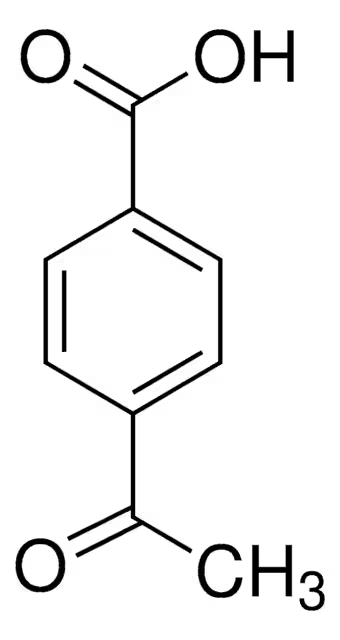
| Linear Formula | CH3COC6H4CO2H |
| Formula Weight | 164.16 |
| Physical Form | Crystal-Powder at 20°C |
| Chemical Name or Material | 4-Acetylbenzoic acid |
| Molecular Weight | 164.16 g/mol |
| SMILES String | CC(=O)c1ccc(cc1)C(O)=O |
| Assay | 98% |
| CAS Number | 586-89-0 |
| EC Number | 209-588-5 |
| Empirical Formula | C9H8O3 |
| NACRES | NA.22 |
| PubChem Substance ID | 24850637 |
| UNSPSC Code | 12352100 |
| MDL Number | MFCD00002561 |
| InChI | 1S/C9H8O3/c1-6(10)7-2-4-8(5-3-7)9(11)12/h2-5H,1H3,(H,11,12) |
| InChI Key | QBHDSQZASIBAAI-UHFFFAOYSA-N |
| PubChem CID | 11470 |
| Beilstein/REAXYS Number | 2207355 |
| Quality Level | 100 |
| Functional Groups | Carboxylic acid, ketone |
| Form | Solid (white to pale yellow crystal-powder) |
4-Acetylbenzoic acid is an aromatic keto acid with the formula C9H8O3 and a molecular weight of 164.16 g/mol. The para relationship of the two groups gives a rigid, linear geometry, and both groups are electron-withdrawing, so the ring is deactivated towards electrophilic substitution. It is a different compound from 2-acetylbenzoic acid and 3-acetylbenzoic acid, which are positional isomers with different CAS numbers and melting points, and from methyl 4-acetylbenzoate, the corresponding ester.
The compound is chosen when a synthetic route needs a carboxylic acid and a ketone on opposite sides of a benzene ring. Drug-discovery teams use it to attach a para-acetylphenyl group through an amide bond and then elaborate the ketone; materials chemists use it as a precursor to carboxy-functional chalcones and polymers. In the published literature it appears as an intermediate in the preparation of a paclitaxel ester derivative.
The grade offered is 98% assay. Ask for the Certificate of Analysis of the lot, and for the isomer profile or the terephthalic acid content if your downstream chemistry is sensitive to diacid impurities. Store in a tightly closed container in a cool, dry place, away from strong oxidisers and strong bases. The powder is slightly acidic and low in solubility in cold water; it dissolves in alcohols, DMSO and aqueous base.
Avoid generating dust, avoid contact with eyes and skin and wash hands thoroughly after use.
No related products found.
It is used as a bifunctional building block: the carboxylic acid forms amides and esters, and the aryl methyl ketone undergoes aldol, reduction, oxidation and condensation chemistry. It has been used in the preparation of an ester derivative of paclitaxel.
Yes. 4-Acetylbenzoic acid, p-acetylbenzoic acid and 4-carboxyacetophenone are the same compound, CAS 586-89-0. The 2- and 3-acetyl isomers are different compounds.
The formula is C9H8O3, the molecular weight is 164.16 g/mol and the melting point is 208–210 °C. The assay is 98%.
By haloform oxidation of the methyl ketone with hypohalite, which gives terephthalic acid (benzene-1,4-dicarboxylic acid) and a haloform.
No hazard classification is published for this compound. Handle it as a fine organic powder, with gloves, eye protection and a dust mask.
Keep it tightly closed in a cool, dry place away from strong oxidisers and strong bases.
Yes. A Certificate of Analysis and Safety Data Sheet accompany every lot of SKU S2317, and bulk quantities can be quoted on request.