

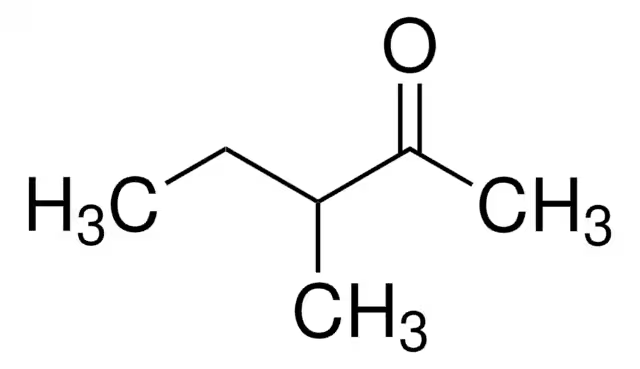
| Boiling Point | 118°C at 758 mmHg (lit.) |
| Density | 0.815 g/mL at 25°C (lit.) |
| Flash Point | 12°C (53.6°F), closed cup |
| Color | Yellow |
| Linear Formula | CH3CH2CH(CH3)COCH3 |
| Formula Weight | 100.16 |
| Physical Form | Clear Liquid at 20°C |
| Chemical Name or Material | 3-Methyl-2-pentanone |
| UN Number | 1224 |
| Molecular Weight | 100.16 g/mol |
| SMILES String | CCC(C)C(C)=O |
| Assay | 99% |
| CAS Number | 565-61-7 |
| EC Number | 209-282-1 |
| Empirical Formula | C6H12O |
| NACRES | NA.22 |
| PubChem Substance ID | 24897107 |
| UNSPSC Code | 12352100 |
| MDL Number | MFCD00009336 |
| InChI | 1S/C6H12O/c1-4-5(2)6(3)7/h5H,4H2,1-3H3 |
| InChI Key | UIHCLUNTQKBZGK-UHFFFAOYSA-N |
| PubChem CID | 11262 |
| Quality Level | 100 |
| Functional Groups | Ketone |
| Form | Liquid (clear liquid at 20°C) |
3-Methyl-2-pentanone is a saturated aliphatic ketone with the formula C6H12O and a molecular weight of 100.16 g/mol. The carbonyl is at C2 and a methyl branch sits on C3, which makes C3 a stereocentre; the commercial CAS number 565-61-7 refers to the compound without a defined configuration. Its boiling point, 118 °C at 758 mmHg, is very close to that of methyl isobutyl ketone (MIBK, 4-methyl-2-pentanone), so the two cannot be told apart by distillation and are separated by GC.
As with other low-molecular-weight ketones, it is miscible with most organic solvents and only partly soluble in water, and it forms flammable vapour-air mixtures at room temperature because its flash point is 12 °C.
In industry and research the compound is used mainly as a solvent and as an intermediate. As a solvent it belongs to the same family as MEK and MIBK and is chosen where its evaporation rate, solvency and odour fit a formulation or an extraction. As an intermediate, the methyl ketone function supports the classic transformations: aldol and Claisen–Schmidt condensations, haloform oxidation to 2-methylbutanoic acid, reductive amination, Baeyer–Villiger oxidation and organometallic additions.
The unsymmetrical structure is the point of interest for R&D teams. Deprotonation with a bulky base at low temperature favours the less substituted methyl enolate, while equilibrating conditions favour the more substituted enolate, giving two different regioisomeric products from the same starting material.
The grade offered is 99% assay. For solvent use, ask for water content and residue on evaporation on the Certificate of Analysis; for synthesis, ask for GC purity and the isomer profile, because other C6 ketones can be present in trace amounts. Store in tightly closed containers in a flammables cabinet away from heat, sparks and oxidisers, and ground and bond containers during transfer. The product ships as UN 1224, ketones, liquid, n.o.s.
Keep away from heat, hot surfaces, sparks and open flames. Use explosion-proof equipment, ground and bond containers, and work in a ventilated area or fume hood.
No related products found.
It is used as a medium-boiling ketone solvent and as an intermediate in organic and pharmaceutical synthesis, where its methyl ketone group supports aldol, haloform, reductive amination, Baeyer–Villiger and Grignard chemistry.
Yes. 3-Methyl-2-pentanone, methyl sec-butyl ketone, sec-butyl methyl ketone and 3-methylpentan-2-one are the same compound, CAS 565-61-7. It differs from methyl isobutyl ketone (4-methyl-2-pentanone, CAS 108-10-1).
The formula is C6H12O, the molecular weight is 100.16 g/mol and the boiling point is 118 °C at 758 mmHg. The density is 0.815 g/mL at 25 °C.
Highly flammable: the closed-cup flash point is 12 °C and it carries hazard statement H225 (Flam. Liq. 2). Keep it away from ignition sources and use grounded, explosion-proof equipment.
Yes. Carbon 3 carries four different groups, so the molecule has one stereocentre, but the product is supplied without a defined configuration under CAS 565-61-7. The stereocentre is next to the carbonyl and can epimerise through the enol under acidic or basic conditions.
Store it tightly closed in a cool, well-ventilated flammables cabinet away from oxidisers. It ships as UN 1224, ketones, liquid, n.o.s.
Yes. For SKU S1760, a Certificate of Analysis and Safety Data Sheet come with each lot, and quotations cover laboratory through bulk quantities.



