CAS: 2859-68-9
SKU: S1858
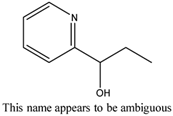
2-Pyridine propanol | SKU: S1858

Specifications

AppearanceN/A
Content of ZincN/A
Boiling PointN / A
Melting PointN/A
Vapor PressureN/A
% Volatile by WeightN/A
Solubility in WaterN/A
DensityN/A
pH of Liquid, Typical (10% soln)N/A
Specific Gravity ApproxN/A
OdorN/A
pHN/A
Flash PointN/A
Ignition temperatureN/A
Lower exposure limitN/A
Upper exposure limitN/A

Applications

No Application Found

Product Description

Please provide the synonym list for PubChem CID: 72922, and I will create the short description for you.

Safety Information

No Safety Information Available.

Related Products

FAQs: 2-Pyridine propanol

Pyridine's molecular weight determines its reactivity and stability. Understanding its weight is critical for identifying the correct concentration in chemical reactions, resulting in practical synthesis in medicines and industrial operations.

Pyridine's molecular structure is a six-membered ring with five carbon atoms and one nitrogen atom, making it an adaptable building block for various chemical processes. This structure is critical to its employment in multiple applications, including solvents and active medicinal compounds.

Propanol's molecular structure, which includes a three-carbon chain with a hydroxyl group (-OH), makes it a highly reactive solvent or intermediary in various chemical reactions, including the creation of alcohol-containing compounds.

Pyridine's molecular weight is critical for correct stoichiometric calculations, which is especially crucial in chemical synthesis and when combined with other substances, such as Propanol, in formulations or reactions.

Pyridine's molecular structure, with its nitrogen atom, enables it to serve as a strong base and polar solvent. This impacts its solubility and reactivity in organic chemistry, particularly when interacting with alcohols such as Propanol.