| Boiling Point | 186–187°C at 160 mmHg (lit.) |
| Melting Point | 37–40°C (lit.) |
| Density | 1.947 g/mL at 25°C (lit.) |
| Flash Point | 113°C, closed cup |
| Color | Undesignated |
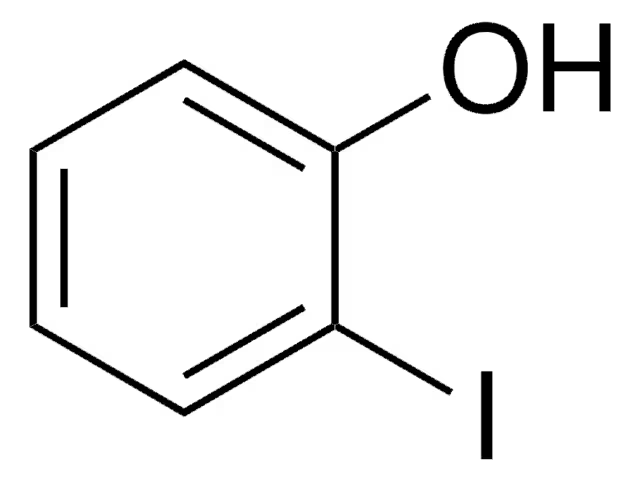
| Linear Formula | IC6H4OH |
| Formula Weight | 220.01 |
| Physical Form | Crystal-Powder at 20°C |
| Chemical Name or Material | 2-Iodophenol |
| Molecular Weight | 220.01 g/mol |
| SMILES String | Oc1ccccc1I |
| Assay | 98% |
| CAS Number | 533-58-4 |
| EC Number | 208-569-9 |
| Empirical Formula | C6H5IO |
| NACRES | NA.22 |
| PubChem Substance ID | 24856973 |
| UNSPSC Code | 12352100 |
| MDL Number | MFCD00013963 |
| InChI | 1S/C6H5IO/c7-5-3-1-2-4-6(5)8/h1-4,8H |
| InChI Key | KQDJTBPASNJQFQ-UHFFFAOYSA-N |
| PubChem CID | 10784 |
| Quality Level | 100 |
| Functional Groups | Iodo |
| Form | Solid |
2-Iodophenol is a monoiodinated phenol with the formula C6H5IO and a molecular weight of 220.01 g/mol. It is one of three positional isomers (2-, 3- and 4-iodophenol), each with its own CAS number; the ortho isomer is distinguished by the proximity of OH and I, which allows chelation-assisted metal catalysis and ring closure. It is a low-melting solid (37–40 °C), so in warm conditions it may be received as a solid mass or partially melted.
Like most iodoarenes, it can discolour slowly on exposure to light as traces of iodine are released, so it is best stored in amber glass or in the dark.
2-Iodophenol is chiefly used as a coupling partner in palladium and copper catalysis. The aryl iodide undergoes oxidative addition under mild conditions, which allows reactions at lower temperature and catalyst loading than the bromo or chloro analogues, and the phenol oxygen then closes the ring. That pairing underpins benzofuran, chromone, flavone and dihydrobenzofuran syntheses, and it is why the compound is so common in medicinal-chemistry route scouting. It is also used in Ullmann-type diaryl ether formation and as a starting material for ortho-functionalised phenols.
The grade offered is 98% assay. For catalytic couplings, ask for the Certificate of Analysis of the lot and tell us if your catalyst system is sensitive to trace impurities. Keep the container tightly closed and protected from light, in a cool, dry place, and away from strong oxidisers and strong bases. Because the melting point is close to ambient temperature, the material may arrive partly fused; weigh it as a solid in a cool room or melt it gently in a closed container before sampling.
Avoid breathing dust or vapour, avoid skin contact and handle in a fume hood.
No related products found.
It is mainly used as a coupling partner for palladium- and copper-catalysed reactions that build oxygen heterocycles. Sonogashira coupling with alkynes followed by cyclisation gives benzofurans, and carbonylative cyclisation and dihydrobenzofuran syntheses use it as well.
They are positional isomers. In 2-iodophenol the iodine is ortho to the hydroxyl group, which enables cyclisation chemistry; in 4-iodophenol the iodine is para, which suits simple cross-couplings. Their CAS numbers and melting points differ.
The formula is C6H5IO, the molecular weight is 220.01 g/mol and the melting point is 37–40 °C. The assay is 98%.
The carbon–iodine bond undergoes oxidative addition to palladium(0) more readily than carbon–bromine, so reactions often proceed at lower temperature or with lower catalyst loading.
It is harmful by ingestion, skin contact and inhalation (H302 + H312 + H332), irritates the skin, eyes and respiratory tract (H315, H319, H335), and carries the signal word Warning.
Store it tightly closed in a cool, dry place and protect it from light, because iodophenols slowly darken with light exposure. Its low melting point means it can soften in warm storage.
Yes. SKU S1665 is supplied with a lot-specific Certificate of Analysis and Safety Data Sheet, and Sarchem Labs provides quotes from laboratory packs to bulk volumes.