| Melting Point | 201–204°C (lit.) |
| Linear Formula | (CH3)2NCH2CH2Cl · HCl |
| Formula Weight | 144.05 |
| Chemical Name or Material | 2-Dimethylaminoethyl chloride hydrochloride |
| UN Number | 2811 |
| Molecular Weight | 144.04 g/mol |
| SMILES String | Cl.CN(C)CCCl |
| Solubility Information | Soluble in water (2000mg/ml at 20°C),and alcohol. |
| Sensitivity | Hygroscopic |
| Beilstein | 3591234 |
| Assay | 99% |
| Solubility | Soluble in water (2,000 mg/mL at 20°C) and alcohol |
| CAS Number | 4584-46-7 |
| EC Number | 224-970-1 |
| Empirical Formula | C4H10ClN · HCl (C4H11Cl2N) |
| NACRES | NA.22 |
| PubChem Substance ID | 24893432 |
| UNSPSC Code | 12352100 |
| MDL Number | MFCD00012516 |
| InChI | 1S/C4H10ClN.ClH/c1-6(2)4-3-5;/h3-4H2,1-2H3;1H |
| InChI Key | LQLJZSJKRYTKTP-UHFFFAOYSA-N |
| PubChem CID | 11636816 |
| Beilstein/REAXYS Number | 3591234 |
| Quality Level | 200 |
| Functional Groups | Amine |
| Form | Crystals |
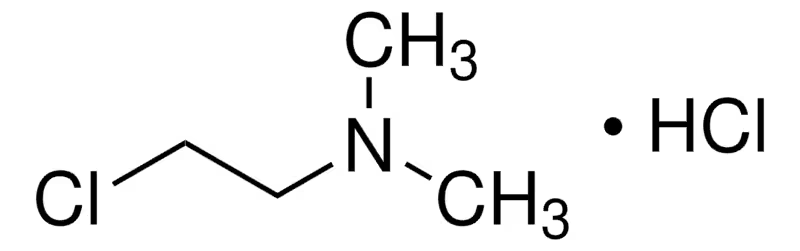
It is the hydrochloride of N,N-dimethyl-2-chloroethylamine, (CH3)2NCH2CH2Cl · HCl, with a molecular weight of 144.04 g/mol and a melting point of 201–204 °C. The molecule combines a tertiary amine and a primary alkyl chloride two carbons apart, which is the structural pattern of a 2-haloethylamine. Protonation of the nitrogen in the hydrochloride suppresses the intramolecular cyclisation that would otherwise occur, so the salt is the stable form for storage and shipping.
Sigma-Aldrich lists the reference material as 99% pure crystals classed as a combustible solid, with hazard classifications for acute oral toxicity, suspected germ-cell mutagenicity, repeated-exposure organ toxicity and chronic aquatic toxicity.
In industrial synthesis, the reagent is released from its hydrochloride with a base in situ and reacts as an alkylating agent. Typical reactions are O-alkylation of phenoxides and N-alkylation of heterocycles, which attach a dimethylaminoethyl chain that improves water solubility and can be quaternised or oxidised in later steps. Process chemists value it as a cost-effective way to introduce this side chain.
Chemicals of this type are controlled because of their potential misuse. Purchasers should be prepared to confirm lawful end use and to meet record-keeping and reporting obligations. Anyone planning to store, ship or export the material should confirm the requirements under the Chemical Weapons Convention as implemented in their country, for example the U.S. Chemical Weapons Convention Regulations, as well as transport, workplace-safety and hazardous-waste rules.
2-Chloro-N,N-dimethylethylamine hydrochloride is listed in Schedule 2 (Part B) of the Chemical Weapons Convention. Production, processing, consumption, import and export are subject to declaration, licensing and end-use controls under national implementing laws, and transfers to non-States Parties are prohibited. Sarchem Labs lists the compound for lawful industrial and research customers only, and sale is subject to compliance screening. This page is for information and does not constitute legal advice.
Based on Sigma-Aldrich’s verified classification (D141208).
As a 2-haloethylamine it is a potential alkylating agent: handle only in a fume hood, avoid all skin contact and inhalation, keep the container tightly closed because the salt is hygroscopic, and obtain special instructions before use. Dispose of waste as hazardous chemical waste.
No related products found.
It is used as an alkylating intermediate that attaches a 2-(dimethylamino)ethyl group in pharmaceutical, dye, surfactant and cationic-polymer manufacture, and as a substrate in mechanistic studies of aziridinium formation.
Yes. 2-Chloro-N,N-dimethylethylamine hydrochloride, 2-dimethylaminoethyl chloride hydrochloride and N-(2-chloroethyl)dimethylamine hydrochloride are the same compound, CAS 4584-46-7.
Yes. It is listed in Schedule 2 (Part B) of the Chemical Weapons Convention and is subject to national declaration, licensing and export controls. Purchasers must be able to meet the applicable regulatory requirements.
The formula is (CH3)2NCH2CH2Cl · HCl, the molecular weight is 144.04 g/mol and the literature melting point is 201–204 °C.
Sigma-Aldrich classifies it as harmful if swallowed (H302), suspected of causing genetic defects (H341), harmful to organs through repeated exposure (H373) and toxic to aquatic life (H411). Use a fume hood, gloves, eye or face protection and respiratory protection as indicated.
The free base cyclises to a reactive aziridinium ion and is unstable on storage. Protonating the nitrogen as the hydrochloride makes the compound a stable, crystalline, storable solid.
Yes. A Certificate of Analysis and Safety Data Sheet accompany each lot of SKU S1451, which is supplied only to purchasers who can meet the applicable regulatory requirements.