

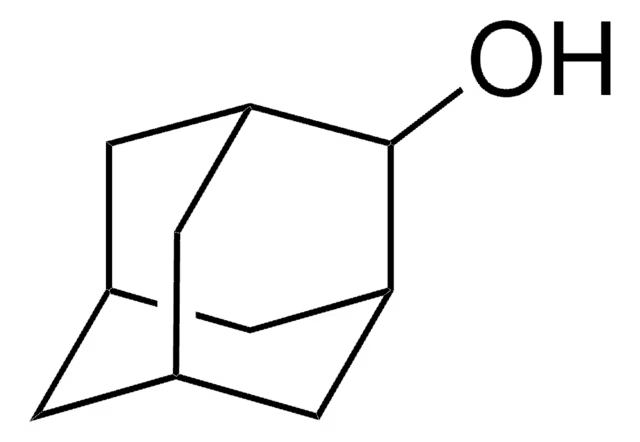
| Melting Point | 258–262°C (lit.) |
| Chemical Name or Material | Adamantan-2-ol |
| Molecular Weight | 152.23 g/mol |
| SMILES String | C1C2CC3CC1CC(C2)C3O |
| Assay | 97% |
| CAS Number | 700-57-2 |
| EC Number | 211-846-7 |
| NACRES | NA.22 |
| PubChem Substance ID | 24849378 |
| UNSPSC Code | 12352100 |
| MDL Number | MFCD00074744 |
| InChI | 1S/C10H16O/c11-10-8-2-6-1-7(4-8)5-9(10)3-6/h6-11H,1-5H2 |
| InChI Key | FOWDOWQYRZXQDP-UHFFFAOYSA-N |
| PubChem CID | 64149 |
| Beilstein/REAXYS Number | 2498536 |
| Quality Level | 100 |
| Functional Groups | Hydroxyl (secondary) |
| Form | Solid (white) |
| Empirical Formula (Hill Notation) | C10H16O |
2-Adamantanol is the monohydroxy derivative of adamantane (tricyclo[3.3.1.1³,⁷]decane) with the hydroxyl on a secondary carbon. The formula is C10H16O and the molecular weight is 152.23 g/mol. It is achiral, because the 2-position lies on a mirror plane of the cage. It is a different compound from 1-adamantanol (the tertiary, bridgehead alcohol, CAS 768-95-6) and 2-adamantanone (the ketone), and each behaves differently: 1-adamantanol forms a tertiary carbocation readily, whereas 2-adamantanol behaves as a hindered secondary alcohol.
The alcohol is bought mainly as an intermediate. Oxidation (with chromium-free reagents such as hypochlorite/TEMPO or Swern-type conditions) gives 2-adamantanone, which reacts with Grignard and organolithium reagents to give 2-alkyl-2-adamantanols; esterification of those tertiary alcohols with acryloyl or methacryloyl chloride gives the acid-sensitive monomers used in photoresist research. The alcohol is also used directly, as a bulky, lipophilic protecting or capping group.
The grade offered is 97% assay. Ask for the Certificate of Analysis of the lot, and tell us if you need low residual 1-adamantanol or 2-adamantanone for polymer or electronic applications. Store in a tightly closed container in a cool, dry place. The solid is stable at room temperature; like other adamantane derivatives it can sublime slowly when heated, so avoid open heating. Use gloves, eye protection and a dust mask when weighing the powder.
Although no hazard classification is published, handle it as a fine organic powder: avoid generating dust, avoid contact with eyes and skin, and wash hands after use.
No related products found.
It is used as an intermediate for 2-adamantanone, adamantyl esters and ester imides, and for 2-alkyl-2-adamantanol derivatives used in photoresist monomer chemistry, and as a lipophilic building block in medicinal chemistry.
No. 2-Adamantanol (CAS 700-57-2) is a secondary alcohol on a methylene bridge carbon. 1-Adamantanol (CAS 768-95-6) is the tertiary bridgehead alcohol. Their reactivity and melting points differ.
The formula is C10H16O, the molecular weight is 152.23 g/mol and the melting point is 258–262 °C. The assay is 97%.
No. The carbinol carbon lies on a mirror plane of the adamantane cage, so the molecule is achiral.
By oxidation of the secondary alcohol, for example with hypochlorite and a nitroxyl catalyst, with Swern-type conditions or with chromium reagents.
Keep it tightly closed in a cool, dry place at room temperature. Adamantane derivatives can sublime when heated.
Yes. The Certificate of Analysis and Safety Data Sheet for each lot of SKU S1012 are provided with the shipment, and bulk quantities can be quoted on request.



