| Melting Point | 278°C (dec.) (lit.) |
| Color | Undesignated |
| Formula Weight | 425.06 |
| Physical Form | Crystal-Powder at 20°C |
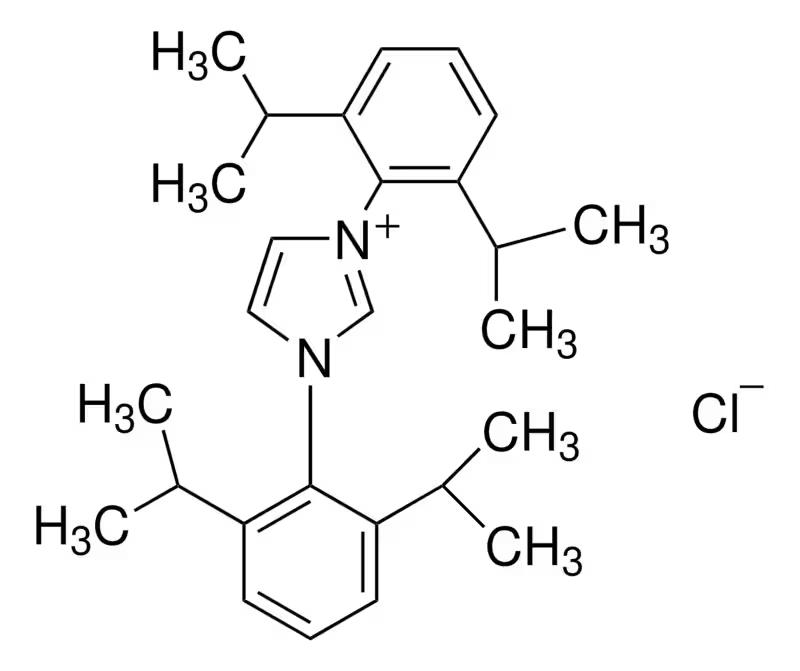
| Chemical Name or Material | 1,3-Bis(2,6-diisopropylphenyl)imidazolium chloride |
| Molecular Weight | 425.05 g/mol |
| SMILES String | [Cl-].CC(C)c1cccc(C(C)C)c1-n2cc[n+](c2)-c3c(cccc3C(C)C)C(C)C |
| Assay | 97% |
| CAS Number | 250285-32-6 |
| NACRES | NA.22 |
| PubChem Substance ID | 24880705 |
| UNSPSC Code | 12352005 |
| MDL Number | MFCD02684545 |
| InChI | 1S/C27H37N2.ClH/c1-18(2)22-11-9-12-23(19(3)4)26(22)28-15-16-29(17-28)27-24(20(5)6)13-10-14-25(27)21(7)8;/h9-21H,1-8H3;1H/q+1;/p-1 |
| InChI Key | AVJBQMXODCVJCJ-UHFFFAOYSA-M |
| PubChem CID | 2734913 |
| Reaction Suitability | Reagent type: ligand |
| Quality Level | 200 |
| Form | Solid (crystal-powder at 20°C) |
| Empirical Formula (Hill Notation) | C27H37ClN2 |
IPr·HCl is an organic salt made of a 1,3-bis(2,6-diisopropylphenyl)imidazolium cation and a chloride anion, with the formula C27H37ClN2 and a molecular weight of 425.05 g/mol. “IPr” is the standard abbreviation for the corresponding carbene, 1,3-bis(2,6-diisopropylphenyl)imidazol-2-ylidene. The acidic C2–H proton of the imidazolium ring is removed by base to form that carbene, which then binds to a metal. Sigma-Aldrich lists the 97% reference grade as a solid that melts with decomposition at 278 °C and assigns it the reagent type “ligand”.
IPr-based catalysts combine high activity with robust, well-defined structures. In palladium catalysis, the size of the ligand favours the reductive-elimination step and its strong donation speeds oxidative addition into unreactive aryl chlorides, which is why Pd–NHC systems are used for Suzuki–Miyaura couplings and C–N bond formation at low catalyst loadings. In gold catalysis, [(IPr)AuCl] activated with a silver salt is a benchmark catalyst for alkyne and allene transformations, and nickel and copper complexes of IPr appear in cross-coupling, hydrosilylation and borylation methods.
Using the preformed salt rather than the free carbene avoids handling an air- and moisture-sensitive solid: the carbene is generated only when it is needed, in the same flask as the metal precursor if desired. This convenience is why imidazolium salts such as IPr·HCl dominate the NHC ligand market.
Check the assay and the water content on the Certificate of Analysis, since imidazolium chlorides can retain traces of water or solvent that matter when the salt is deprotonated with a strong base. Keep the container tightly closed in a dry place. Sigma-Aldrich assigns the compound to storage class 6.1A (very toxic hazardous materials) with the hazard statement H300 (fatal if swallowed), so weigh it in a fume hood or glove box, avoid creating dust and follow your site’s procedures for acutely toxic solids. Because it is also very toxic to aquatic life (H410), collect all waste as hazardous waste and keep it out of drains.
Based on Sigma-Aldrich’s verified classification (574074).
Do not eat, drink or smoke where the material is used, and wash hands thoroughly after handling.
No related products found.
It is the precursor to the bulky N-heterocyclic carbene ligand IPr, used to make palladium, nickel, gold, copper and ruthenium catalysts for cross-coupling, olefin metathesis, alkyne activation and related transformations.
IPr is the free carbene, an air- and moisture-sensitive species. IPr·HCl is its stable imidazolium chloride salt, which releases IPr when it is deprotonated by a base.
Treat the salt with a strong, non-nucleophilic base such as potassium tert-butoxide, sodium hydride or KHMDS in an anhydrous solvent under inert gas. Many catalysts are prepared by mixing the salt, a base and a metal precursor in one flask.
The formula is C27H37ClN2, the molecular weight is 425.05 g/mol and the literature melting point is 278 °C with decomposition.
Sigma-Aldrich classifies it as fatal if swallowed (H300), causing serious eye damage (H318), a respiratory irritant (H335) and very toxic to aquatic life (H410). Handle it in a fume hood with gloves, eye protection and a dust mask.
The imidazolium salt is a stable solid that can be handled in air for weighing, whereas the free carbene is not. Keep the container tightly closed and dry, and dry the salt before use if the downstream chemistry is moisture-sensitive.
Yes. Sarchem Labs provides a Certificate of Analysis and Safety Data Sheet with every lot of SKU S2961 and quotes bulk quantities on request.