

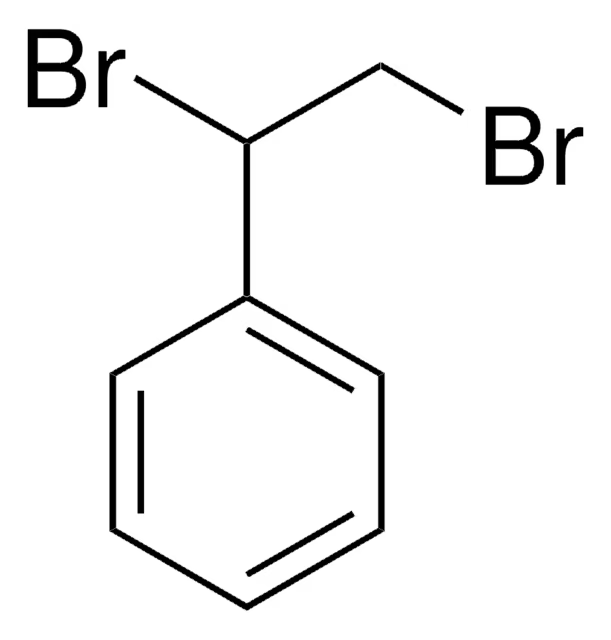
| Boiling Point | 139–141°C at 15 mmHg (lit.) |
| Melting Point | 70–74°C (lit.) |
| Color | White-Yellow |
| Linear Formula | C6H5CH(Br)CH2Br |
| Formula Weight | 263.96 |
| Physical Form | Crystal-Powder at 20°C |
| Chemical Name or Material | (1,2-Dibromoethyl)benzene |
| UN Number | 1759 |
| Molecular Weight | 263.96 g/mol |
| SMILES String | BrCC(Br)c1ccccc1 |
| Assay | ≥98% |
| CAS Number | 93-52-7 |
| EC Number | 202-253-4 |
| Empirical Formula | C8H8Br2 |
| NACRES | NA.22 |
| PubChem Substance ID | 24850710 |
| UNSPSC Code | 12352100 |
| MDL Number | MFCD00000138 |
| InChI | 1S/C8H8Br2/c9-6-8(10)7-4-2-1-3-5-7/h1-5,8H,6H2 |
| InChI Key | SHKKTLSDGJRCTR-UHFFFAOYSA-N |
| PubChem CID | 7145 |
| Beilstein/REAXYS Number | 907323 |
| Quality Level | 100 |
| Functional Groups | Bromo, phenyl |
| Form | Solid (white to yellow crystals) |
(1,2-Dibromoethyl)benzene is the product of adding bromine across the double bond of styrene. Its formula is C8H8Br2 and its molecular weight is 263.96 g/mol. One bromine is attached to the carbon that carries the phenyl ring, which makes it benzylic and prone to SN1-type ionisation, and the other is on a primary carbon. The compound is a crystalline solid at room temperature that melts at 70–74 °C.
It should not be confused with (2,2-dibromoethyl)benzene or with 1,2-dibromoethane (ethylene dibromide), both of which are different compounds with different CAS numbers.
In practice it is used as a stable, solid equivalent of “styrene plus bromine” for generating alkynes and vinyl bromides. Elimination of HBr under strong base proceeds stepwise, so the conditions can be tuned to stop at the vinyl bromide or to continue to phenylacetylene. For heterocycle chemists, the two bromines provide a 1,2-biselectrophile with a built-in phenyl substituent.
The grade offered is at least 98%. Ask for the Certificate of Analysis of the lot, and for the water and free-acid content if your base-sensitive chemistry needs it, because benzylic bromides slowly release HBr in moist air. Store in a tightly closed container, cold and dry, protected from light, and away from bases, oxidisers and metals. The product is corrosive and ships as UN 1759 (corrosive solid, n.o.s.). Use a face shield, gloves, eye protection and a fume hood.
Corrosive: avoid all contact with skin and eyes, do not breathe dust, and use in a fume hood. In case of contact, remove contaminated clothing and rinse the skin or eyes with water for several minutes before obtaining medical attention.
No related products found.
It is mainly used to make phenylacetylene by double dehydrobromination, to make bromostyrenes by single dehydrobromination, and as a 1,2-biselectrophile in heterocycle synthesis.
Yes. (1,2-Dibromoethyl)benzene, styrene dibromide, α,β-dibromoethylbenzene and 1,2-dibromo-1-phenylethane are the same compound, CAS 93-52-7.
The formula is C8H8Br2, the molecular weight is 263.96 g/mol and the melting point is 70–74 °C. The boiling point is 139–141 °C at 15 mmHg and the assay is at least 98%.
Two equivalents of HBr are removed with a strong base, for example sodium amide in liquid ammonia or alkali under phase-transfer conditions. Stopping after one elimination gives a bromostyrene.
It causes severe skin burns and eye damage (H314, Skin Corr. 1B) and carries the signal word Danger. Use a face shield, gloves and a fume hood.
Keep it tightly closed in a cool, dry place away from light, bases and oxidisers. Benzylic bromides slowly release HBr in moist air.
Yes. Sarchem Labs provides a Certificate of Analysis and Safety Data Sheet with every lot of SKU S2427 and quotes bulk quantities on request.



