| Melting Point | 111–113°C (lit.) |
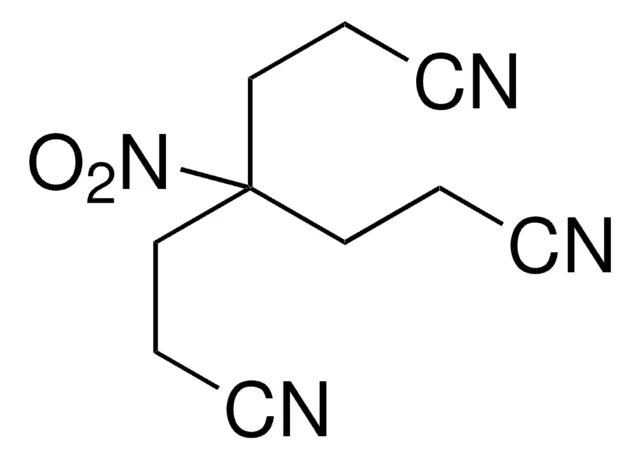
| Linear Formula | NO2C(CH2CH2CN)3 |
| Chemical Name or Material | Tris(2-cyanoethyl)nitromethane (4-cyano-4-nitroheptanedinitrile) |
| Molecular Weight | 220.23 g/mol |
| SMILES String | [O-][N+](=O)C(CCC#N)(CCC#N)CCC#N |
| Assay | 95% |
| CAS Number | 1466-48-4 |
| EC Number | 215-983-3 |
| Empirical Formula | C10H12N4O2 |
| NACRES | NA.22 |
| PubChem Substance ID | 24861951 |
| UNSPSC Code | 12352100 |
| MDL Number | MFCD00013830 |
| InChI | 1S/C10H12N4O2/c11-7-1-4-10(14(15)16,5-2-8-12)6-3-9-13/h1-6H2 |
| InChI Key | MUPJJZVGSOUSFH-UHFFFAOYSA-N |
| PubChem CID | 73841 |
| Beilstein/REAXYS Number | 1789382 |
| Quality Level | 100 |
| Functional Groups | Nitrile, nitro |
| Form | Solid |
It is a tetrasubstituted methane in which one carbon is bonded to a nitro group and to three –CH2CH2CN groups. The formula is C10H12N4O2 and the molecular weight is 220.23 g/mol. It is prepared by the triple Michael addition of nitromethane to acrylonitrile, using a strongly basic catalyst such as trimethylphenylammonium hydroxide. The nitro group stabilises the carbanion at each stage and ends up on a quaternary carbon.
The name is sometimes mis-typed as “tris(2-cyanomethyl)nitromethane”; the correct arms are 2-cyanoethyl (–CH2CH2CN), which is what the CAS number 1466-48-4 and the formula C10H12N4O2 describe.
The compound is bought as a core molecule. Because the three arms are identical and the centre is quaternary, every transformation (reduction, hydrolysis, further cyanoethylation) is repeated three times at once, which makes it a convenient starting point for symmetric branched structures. Research groups use it for dendrimer and cascade synthesis, for tetradentate ligands and for polycyclic ammonium salts.
The grade offered is 95% assay. Ask for the Certificate of Analysis of the lot, and tell us your purity requirement if you are building dendrimer generations, because each unreacted arm lowers the yield of the next generation. Store tightly closed in a cool, dry place away from strong bases, strong acids, reducing agents and heat. Avoid strong heating, and run reductions and hydrolyses on scale with controlled addition and cooling because both are exothermic and strong acids can release toxic gases from nitriles.
Avoid breathing dust, avoid contact with skin and eyes, and work in a fume hood.
No related products found.
It is used as a four-directional core molecule for dendrimers and cascade molecules, as a precursor of branched tetraamines and tricarboxylic acids, and as the starting reagent for a tricyclic ammonium salt.
Yes. Tris(2-cyanoethyl)nitromethane and 4-cyano-4-nitroheptanedinitrile are the same compound, CAS 1466-48-4. The "cyanomethyl" spelling sometimes seen is a typing error.
The formula is C10H12N4O2, the molecular weight is 220.23 g/mol and the melting point is 111–113 °C. The assay is 95%.
By the base-catalysed triple Michael addition of nitromethane to three equivalents of acrylonitrile, for example with trimethylphenylammonium hydroxide as the catalyst.
It is harmful if swallowed, in contact with skin or if inhaled (H302 + H312 + H332) and irritates the skin, eyes and airways (H315, H319, H335). Use gloves, eye protection and a fume hood.
Keep it tightly closed in a cool, dry place away from strong bases, acids, reducing agents and heat.
Yes. Sarchem Labs provides a Certificate of Analysis and Safety Data Sheet with every lot of SKU S1990 and quotes bulk quantities on request.