

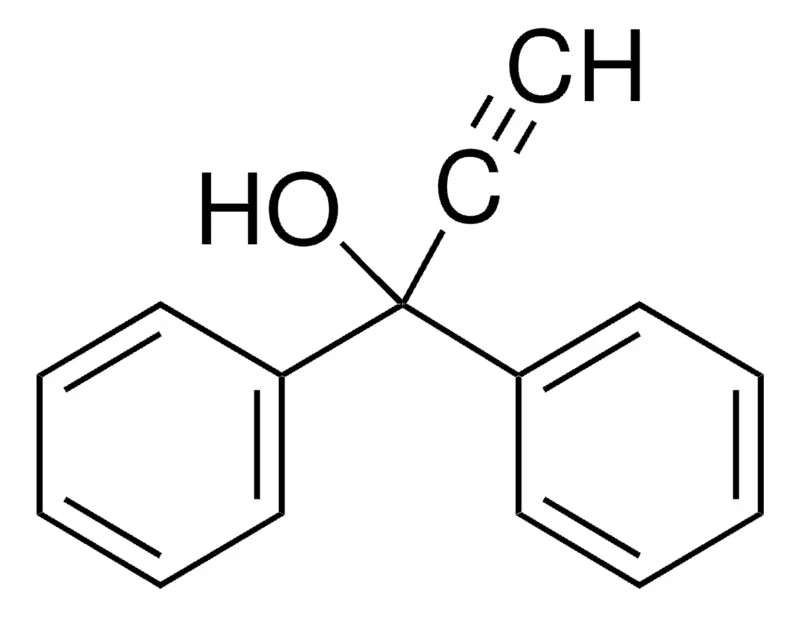
| Boiling Point | 183°C at 20 mmHg (lit.) |
| Melting Point | 47–49°C (lit.) |
| Flash Point | 113°C (235.4°F), closed cup |
| Color | White to yellow |
| Linear Formula | HC≡CC(C6H5)2OH |
| Formula Weight | 208.26 |
| Physical Form | Crystal-Powder at 20°C |
| Chemical Name or Material | 1,1-Diphenyl-2-propyn-1-ol |
| Molecular Weight | 208.26 g/mol |
| SMILES String | OC(C#C)(c1ccccc1)c2ccccc2 |
| Assay | 99% |
| CAS Number | 3923-52-2 |
| Empirical Formula | C15H12O |
| NACRES | NA.22 |
| PubChem Substance ID | 24871373 |
| UNSPSC Code | 12352100 |
| MDL Number | MFCD00041570 |
| InChI | 1S/C15H12O/c1-2-15(16,13-9-5-3-6-10-13)14-11-7-4-8-12-14/h1,3-12,16H |
| InChI Key | SMCLTAARQYTXLW-UHFFFAOYSA-N |
| PubChem CID | 92976 |
| Beilstein/REAXYS Number | 514549 |
| Quality Level | 200 |
| Functional Groups | Hydroxyl, phenyl |
| Form | Solid (crystal-powder at 20°C) |
1,1-Diphenyl-2-propyn-1-ol (C15H12O, 208.26 g/mol) is a tertiary alcohol: the carbinol carbon carries two phenyl rings, a hydroxyl group and an ethynyl group. Sigma-Aldrich classifies it as an alkynol and lists the functional groups hydroxyl and phenyl. Its low melting point (47–49 °C) means that it can be melted for transfers in warm facilities, and its boiling point of 183 °C at 20 mmHg allows purification by vacuum distillation as well as by recrystallisation.
The largest application of 1,1-diarylpropargyl alcohols is the manufacture of photochromic naphthopyrans. In the standard sequence, the alcohol and a naphthol condense under mild acid catalysis and cyclise to give a 3,3-diaryl-3H-naphtho[2,1-b]pyran. Substituents on the aryl rings tune the colour and fading rate of the finished dye, and the unsubstituted diphenyl compound serves as the parent member of the series.
In organometallic chemistry, the same alcohol reacts with ruthenium(II) phosphine precursors to give carbene-type complexes. Sigma-Aldrich lists its use in preparing (PCy3)2Cl2Ru(3-phenylinden-1-ylidene), a ruthenium indenylidene catalyst for olefin metathesis, and in preparing a ruthenium vinylcarbene complex.
Check the melting range and assay on the Certificate of Analysis. Because the solid melts near 47–49 °C it can soften or fuse in warm storage, so keep it in a cool place, tightly closed and away from strong acids, which promote dehydration and Meyer–Schuster rearrangement. Like other terminal alkynes, it can form shock-sensitive acetylides with silver, mercury and, under some conditions, copper(I) salts, so follow your site’s procedures when using those metals. Standard PPE applies: dust mask, eyeshields and gloves.
Based on Sigma-Aldrich’s verified classification (477443).
Avoid dust, avoid contact with eyes and skin, and use with local exhaust ventilation.
No related products found.
It is used to make photochromic naphthopyran and thieno-2H-chromene dyes, as a precursor to ruthenium indenylidene and vinylcarbene complexes for olefin metathesis, and as an alkyne building block for coupling and rearrangement chemistry.
Yes. 1,1-Diphenyl-2-propyn-1-ol, 1,1-diphenylprop-2-yn-1-ol and 1,1-diphenylpropargyl alcohol are the same compound, CAS 3923-52-2, formula C15H12O.
It condenses with a naphthol or phenol under mild acid catalysis and cyclises to a 2,2-diaryl-2H-chromene (naphthopyran). These dyes switch between colourless and coloured forms on exposure to ultraviolet light, which is the basis of photochromic lenses.
The formula is C15H12O, the molecular weight is 208.26 g/mol and the literature melting point is 47–49 °C. It boils at 183 °C at 20 mmHg.
Sigma-Aldrich classifies it as a skin irritant (H315), a serious eye irritant (H319) and a respiratory irritant (H335). Use an N95-type dust mask, eye protection and gloves.
Keep it tightly closed in a cool, dry place away from strong acids and oxidisers. Because it melts near 47–49 °C, avoid warm storage that could fuse the solid.
Yes. The Certificate of Analysis and Safety Data Sheet for each lot of SKU S1496 are provided with the shipment, and bulk quantities can be quoted on request.



