

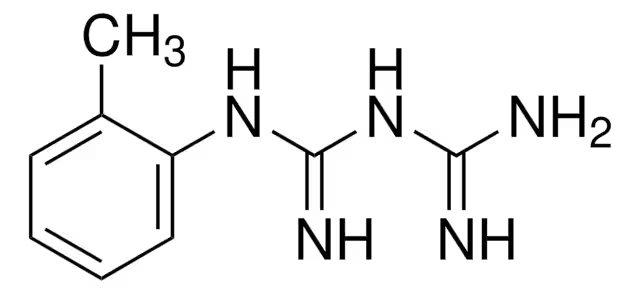
| Melting Point | 143–145°C (lit.) |
| Flash Point | 113°C (235.4°F), closed cup |
| Color | White |
| Linear Formula | CH3C6H4NHC(=NH)NHC(=NH)NH2 |
| Formula Weight | 191.24 |
| Physical Form | Crystal-Powder at 20°C |
| Chemical Name or Material | 1-(2-Methylphenyl)biguanide |
| Molecular Weight | 191.23 g/mol |
| SMILES String | Cc1ccccc1NC(=N)NC(N)=N |
| Assay | 98% |
| CAS Number | 93-69-6 |
| EC Number | 202-268-6 |
| Empirical Formula | C9H13N5 |
| NACRES | NA.22 |
| PubChem Substance ID | 24866583 |
| UNSPSC Code | 12352100 |
| MDL Number | MFCD00019731 |
| InChI | 1S/C9H13N5/c1-6-4-2-3-5-7(6)13-9(12)14-8(10)11/h2-5H,1H3,(H6,10,11,12,13,14) |
| InChI Key | SQZCAOHYQSOZCE-UHFFFAOYSA-N |
| PubChem CID | 7155 |
| Functional Groups | Amine (biguanide) |
| Form | Powder (white) |
1-(o-Tolyl)biguanide is the N1-aryl derivative of biguanide (imidodicarbonimidic diamide), with the formula C9H13N5 and a molecular weight of 191.23 g/mol. It is a strong organic base that is usually handled as a free base or as a salt, and it forms stable chelates with metal ions through two of its nitrogen atoms. It is not the same compound as the antidiabetic drug phenformin (a phenethylbiguanide), as metformin (a dimethylbiguanide) or as 1,3-di-o-tolylguanidine (DOTG); each has a different CAS number and use.
Industrial buyers use the compound where a basic, polyfunctional nitrogen curing agent is needed: it cross-links epoxy resins and powder-coating binders and accelerates rubber vulcanisation. Research groups use it as a ligand scaffold for transition-metal complexes, with vanadyl complexes reported, and as a starting material for substituted triazines, which are an important class of enzyme inhibitors and agrochemical actives.
The grade offered is 98% assay. Ask for the Certificate of Analysis of the lot, and tell us if you need the free base or a salt form, because the properties and handling differ. Store in a tightly closed container in a cool, dry place away from strong acids and oxidisers. The powder causes serious eye damage, so use a face shield or goggles, gloves and an N95-type dust mask when weighing.
Causes serious eye damage: wear eye protection, avoid dust, and in case of eye contact rinse cautiously with water for several minutes and obtain medical attention.
No related products found.
It is used as a curing agent for epoxy resins and powder coatings, as a vulcanisation accelerator, as a ligand for metal complexes (for example vanadyl), and as a starting material for substituted triazines.
No. Metformin is a dimethylbiguanide and phenformin is a phenethylbiguanide. 1-(o-Tolyl)biguanide, CAS 93-69-6, is an aryl biguanide used as an industrial and research chemical.
The formula is C9H13N5, the molecular weight is 191.23 g/mol and the melting point is 143–145 °C. The assay is 98%.
It is harmful if swallowed (H302), irritates the skin and airways (H315, H335) and causes serious eye damage (H318), with the signal word Danger. Use eye protection, gloves and a dust mask.
Yes. Aryl biguanides condense with ketones, esters and orthoesters to give dihydrotriazines and aminotriazines; with acetone, for example, 4-chlorophenylbiguanide gives the antimalarial scaffold cycloguanil.
Keep it tightly closed in a cool, dry place away from strong acids and oxidisers.
Yes. SKU S3317 is supplied with a lot-specific Certificate of Analysis and Safety Data Sheet, and Sarchem Labs provides quotes from laboratory packs to bulk volumes.



