

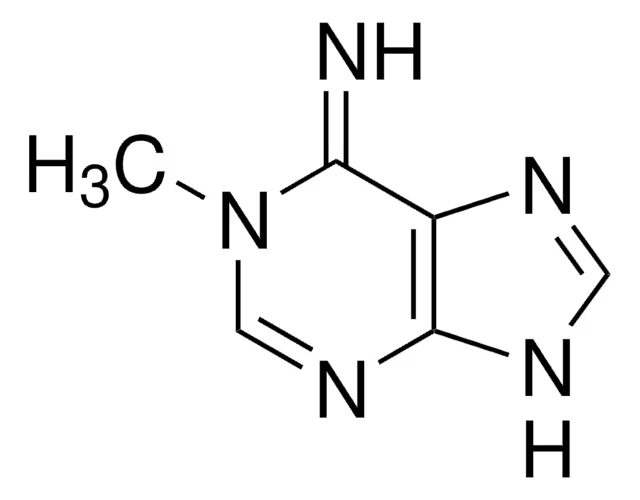
| Melting Point | >300°C (lit.) |
| CAS Min % | 98.0 |
| CAS Max % | 100.0 |
| Color | Beige or yellow |
| Infrared Spectrum | Authentic |
| Assay Percent Range | 98% min. (HPLC) |
| Packaging | Glass bottle |
| Formula Weight | 149.15 |
| Physical Form | Crystalline Powder |
| Chemical Name or Material | 1-Methyladenine (1-methylpurin-6-amine) |
| Molecular Weight | 149.15 g/mol |
| SMILES String | CN1C=NC2=NC=NC2=C1N |
| Identification | IR: authentic |
| Solubility Information | Solubility in water: soluble |
| Beilstein | 26, V,17, 136 |
| Assay | 98% min. (HPLC) |
| Solubility | Soluble in water |
| CAS Number | 5142-22-3 |
| EC Number | 225-907-0 |
| UNSPSC Code | 12352200 |
| MDL Number | MFCD00010532 |
| InChI | 1S/C6H7N5/c1-11-3-10-6-4(5(11)7)8-2-9-6/h2-3H,7H2,1H3 |
| InChI Key | HPZMWTNATZPBIH-UHFFFAOYSA-N |
| PubChem CID | 78821 |
| Form | Crystalline powder |
| Empirical Formula (Hill Notation) | C6H7N5 |
1-Methyladenine is a purine base: adenine with a methyl group on N1 instead of a hydrogen. Its formula is C6H7N5 and its molecular weight is 149.15 g/mol. Because N1 is a ring nitrogen involved in base pairing, methylation there blocks Watson–Crick pairing and, within nucleic acids, adds a positive charge at physiological pH.
It is a different compound from 3-methyladenine (CAS 5142-23-4), a well-known autophagy inhibitor, from 6-methyladenine (N6-methyladenine) and from the nucleoside 1-methyladenosine, which carries a ribose. Check the CAS number, 5142-22-3, when ordering.
For laboratories that study DNA damage, 1-methyladenine is the reference compound for a lesion formed by SN2-type alkylating agents such as methyl methanesulfonate. AlkB-family dioxygenases repair it by hydroxylating the methyl group, which is released as formaldehyde, and the free base is used to calibrate analytical methods that measure how much of the lesion is present. In epitranscriptomics, it is the nucleobase counterpart of m1A, found at defined positions in tRNA and in some mRNA and mitochondrial transcripts.
In reproductive and developmental biology, 1-methyladenine is added to isolated starfish oocytes to trigger germinal-vesicle breakdown and maturation, a model system for studying the control of meiosis.
The grade offered is at least 98% by HPLC, with IR identity. Ask for the Certificate of Analysis of the lot, and tell us if you need a particular water or salt content for quantitative work. Store the powder tightly closed at room temperature in a dry place. Dissolve in water for stock solutions; the base is soluble, and aqueous stocks should be aliquoted and frozen for long-term storage. The compound is supplied for research use only.
Do not eat, drink or smoke when using the product, wash hands thoroughly after handling and wear gloves and eye protection. If swallowed, call a poison centre or doctor if you feel unwell.
No related products found.
It is used in DNA-repair and epitranscriptomics research as a reference for the 1-methyladenine lesion and the m1A modification, in analytical methods for methylated purines, and in developmental biology as the starfish oocyte maturation-inducing substance.
No. 3-Methyladenine (CAS 5142-23-4) is a different isomer and a known autophagy inhibitor, and 1-methyladenosine is the ribonucleoside. 1-Methyladenine is the free base, CAS 5142-22-3.
The formula is C6H7N5, the molecular weight is 149.15 g/mol and the melting point is above 300 °C. The assay is at least 98% by HPLC.
Yes, the base dissolves in water. For quantitative work, prepare stock solutions in water or buffer and verify the concentration by UV absorbance.
It is listed as harmful if swallowed (H302) with the signal word Warning. Wear gloves and eye protection and avoid creating dust.
Keep it tightly closed at room temperature in a dry place. Store aqueous stocks frozen in aliquots.
Yes. Each lot of SKU S3128 ships with a Certificate of Analysis and Safety Data Sheet, and Sarchem Labs quotes laboratory to bulk quantities.



