

| Boiling Point | 74°C |
| Density | 0.946 g/mL at 20°C (lit.) |
| Flash Point | 83°C (181.4°F), closed cup |
| Color | Yellow |
| Formula Weight | 107.16 |
| Physical Form | Clear Liquid at 20°C |
| Chemical Name or Material | Cyclohexene-1-carbonitrile |
| UN Number | 3276 |
| Molecular Weight | 107.15 g/mol |
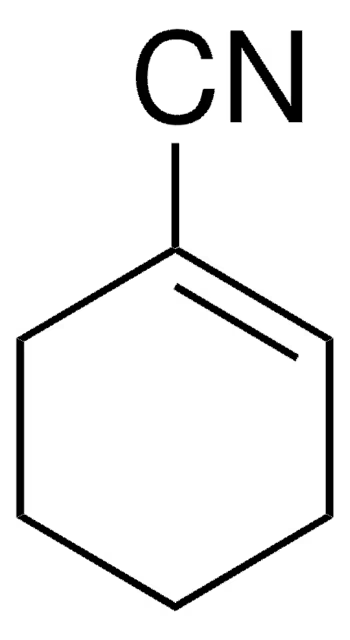
| SMILES String | N#CC1=CCCCC1 |
| Assay | ≥97.0% |
| CAS Number | 1855-63-6 |
| EC Number | 217-454-2 |
| NACRES | NA.22 |
| PubChem Substance ID | 57648352 |
| UNSPSC Code | 12352100 |
| MDL Number | MFCD00013772 |
| InChI | 1S/C7H9N/c8-6-7-4-2-1-3-5-7/h4H,1-3,5H2 |
| InChI Key | GTMWGXABXQTZRJ-UHFFFAOYSA-N |
| PubChem CID | 74619 |
| Beilstein/REAXYS Number | 385837 |
| Quality Level | 100 |
| Functional Groups | Nitrile |
| Form | Liquid (clear liquid at 20°C) |
| Empirical Formula (Hill Notation) | C7H9N |
1-Cyclohexenecarbonitrile is a six-membered carbocycle with one double bond whose sp2 carbon bears a cyano group. Its formula is C7H9N, its molecular weight is 107.15 g/mol and it is a liquid at room temperature with a density of 0.946 g/mL. The nitrile is conjugated to the alkene, so the molecule absorbs in the ultraviolet region, which is the basis of its photochemistry, and it behaves as an electron-poor alkene towards nucleophiles.
It should not be confused with cyclohexanecarbonitrile (the saturated nitrile) or with 3-cyclohexene-1-carbonitrile (a non-conjugated isomer); these have different CAS numbers and reactivity.
The compound is used mainly in research and fine-chemical synthesis. In photochemistry it is a model α,β-unsaturated nitrile whose irradiation gives the bicyclo[3.1.0]hexane skeleton. In synthesis it is used to prepare cyclohexene-1-carboxylic acid and, through conjugate addition, a range of 2-substituted cyclohexane derivatives. Because both the alkene and the nitrile are transformable, the compound is a flexible starting point for building substituted six-membered rings.
The grade offered is at least 97.0%. For catalytic or photochemical work, ask for the Certificate of Analysis of the lot and tell us if your process is sensitive to moisture or trace impurities. Store in a tightly closed container in a cool, well-ventilated place away from heat, strong acids, strong bases and oxidisers. Organic nitriles should be handled in a fume hood; combustion or strong-acid contact can release toxic gases.
Do not eat, drink or smoke when using the product, wash hands thoroughly after handling and dispose of the contents in accordance with local regulations.
No related products found.
It is used as an α,β-unsaturated nitrile in photochemistry, conjugate-addition chemistry and the preparation of cyclohexene-1-carboxylic acid. Irradiation gives bicyclo[3.1.0]hexane-1-carbonitrile.
Yes. 1-Cyclohexenecarbonitrile, cyclohexene-1-carbonitrile, 1-cyanocyclohexene and cyclohexenyl cyanide are the same compound, CAS 1855-63-6.
The formula is C7H9N, the molecular weight is 107.15 g/mol and the density is 0.946 g/mL at 20 °C. The assay is at least 97.0%.
In 1-cyclohexenecarbonitrile the double bond is conjugated with the nitrile, which makes it an electrophilic alkene and a UV-absorbing chromophore. In 3-cyclohexene-1-carbonitrile the double bond is isolated, so the compound behaves as a simple alkene plus a nitrile.
It is classified as harmful if swallowed (H302), with the signal word Warning, and it is a combustible liquid with a flash point of 83 °C. Use a fume hood, gloves and eye protection.
Keep it tightly closed in a cool, well-ventilated place, away from heat, light, strong acids, strong bases and oxidisers.
Yes. The Certificate of Analysis and Safety Data Sheet for each lot of SKU S2589 are provided with the shipment, and bulk quantities can be quoted on request.



