| Melting Point | 210–214°C (dec.) (lit.) |
| Formula Weight | 233.14 |
| Chemical Name or Material | 1-(3-Chlorophenyl)piperazine monohydrochloride |
| UN Number | 2811 |
| Molecular Weight | 233.14 g/mol (monohydrochloride) |
| SMILES String | Cl.Clc1cccc(c1)N2CCNCC2 |
| Sensitivity | Hygroscopic |
| Beilstein | 4768691 |
| Assay | 99% |
| Solubility | Soluble in methanol |
| CAS Number | 13078-15-4 |
| EC Number | 265-718-0 |
| Empirical Formula | C10H13ClN2 · HCl |
| NACRES | NA.22 |
| PubChem Substance ID | 24847652 |
| UNSPSC Code | 12352100 |
| MDL Number | MFCD00039032 |
| InChI | 1S/C10H13ClN2.ClH/c11-9-2-1-3-10(8-9)13-6-4-12-5-7-13;/h1-3,8,12H,4-7H2;1H |
| InChI Key | MHXPYWFZULXYHT-UHFFFAOYSA-N |
| PubChem CID | 25681 |
| Beilstein/REAXYS Number | 4768691 |
| Quality Level | 100 |
| Functional Groups | Chloro |
| Form | Powder |
| Gene Information | Rat: Htr1a (24473) |
| Alternate CAS Number (Hydrochloride) | 65369-76-8 |
| Molecular Weight (Free Base) | 196.68 g/mol |
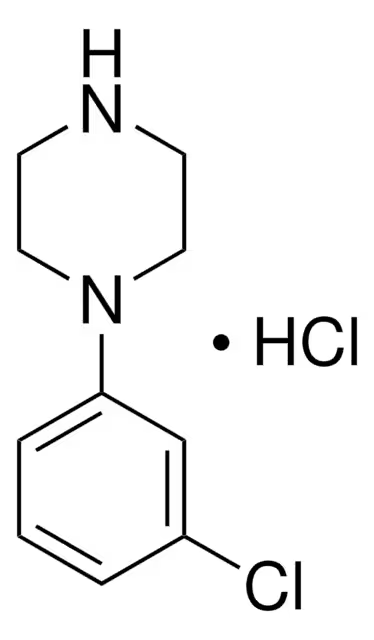
It is the hydrochloride salt of 1-(3-chlorophenyl)piperazine, an arylpiperazine in which a meta-chlorinated benzene ring is bonded to N1 of piperazine, leaving a secondary amine (N4–H) free. The salt formula is C10H13ClN2·HCl (233.14 g/mol; the free base is 196.68 g/mol). The aryl-bearing nitrogen is weakly basic, whereas the free N–H is a typical nucleophilic, basic secondary amine, which is the site used to attach side chains. The hydrochloride is the stable, easily weighed form and is hygroscopic, so it should be kept dry.
The compound appears in registries under more than one CAS number: Sarchem Labs lists it as 13078-15-4, and the hydrochloride is also indexed as 65369-76-8.
In pharmaceutical manufacturing, the 3-chlorophenylpiperazine unit is the pharmacophore of trazodone and nefazodone, and the free base released from the hydrochloride is alkylated with the appropriate side-chain halide to build the drug skeleton. The same unit arises when these drugs are metabolised, which is why the compound is also needed as an analytical standard in pharmacokinetic, forensic and quality-control laboratories.
As a research reagent, mCPP is used to probe serotonin receptor subtypes; it has affinity for 5-HT1A and other receptors, and it reduces food intake in rats, which has made it a standard challenge agent in animal studies of appetite and anxiety.
Controlled-substance rules for arylpiperazines differ widely, and mCPP is the subject of drug-control measures in some jurisdictions. Anyone buying, storing, importing or exporting the compound should confirm the requirements that apply to their location and their intended use before ordering.
1-(3-Chlorophenyl)piperazine is controlled or monitored under drug-control or designer-drug legislation in some countries, and it has been misused as a recreational drug. Sarchem Labs lists the hydrochloride solely as a pharmaceutical intermediate and as an analytical and research reference material for qualified customers. It is not sold for human or animal consumption. Purchasers are responsible for compliance with applicable drug-control, import-export and customs regulations. This notice is not legal advice.
Avoid dust, avoid contact with skin and eyes, and use in a fume hood or with local exhaust ventilation. Keep the container tightly closed because the salt is hygroscopic.
No related products found.
It is used as an intermediate in the manufacture of trazodone and nefazodone, as an analytical reference standard for their major metabolite and for designer-piperazine screening, and as a research tool in serotonin-receptor pharmacology.
Yes. 1-(3-Chlorophenyl)piperazine, m-CPP and mCPP are the same base compound. The monohydrochloride is listed here under CAS 13078-15-4 and is also indexed as 65369-76-8; both refer to the hydrochloride salt.
The 3-chlorophenylpiperazine unit is part of the structure of both drugs, so mCPP is a synthetic intermediate for them and is also formed when they are metabolised. That makes it an important reference compound in drug-metabolism and quality-control work.
The monohydrochloride has a formula weight of 233.14 g/mol (196.68 g/mol for the free base), and the literature melting point is 210–214 °C with decomposition.
Regulation varies by country: it is subject to drug-control measures in some jurisdictions, for example Germany, and not in others. Sarchem Labs supplies it only for lawful intermediate, analytical and research use, and buyers must check local controlled-substance, import and export rules.
Keep it tightly closed in a cool, dry place, because the hydrochloride is hygroscopic. Store it away from strong oxidisers and strong bases.
Yes. A Certificate of Analysis and Safety Data Sheet accompany each lot of SKU S2126, which is supplied only for lawful pharmaceutical-intermediate, analytical and research use.