

| Boiling Point | 142°C (lit.) |
| Melting Point | <−70°C |
| Vapor Pressure | 2.42 psi (20°C) |
| Density | 1.074 g/mL at 25°C (lit.) |
| Odor | Acrid |
| Flash Point | 38°C (100.4°F), closed cup |
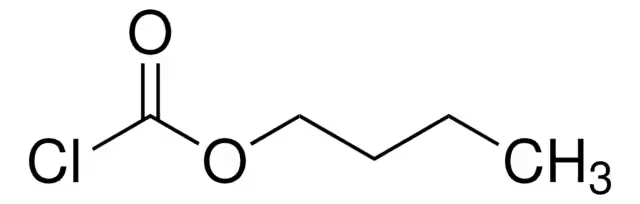
| Linear Formula | ClCOOCH2CH2CH2CH3 |
| Formula Weight | 136.58 |
| Chemical Name or Material | n-Butyl chloroformate |
| UN Number | 2743 |
| Molecular Weight | 136.58 g/mol |
| SMILES String | CCCCOC(Cl)=O |
| Sensitivity | Moisture sensitive |
| Beilstein | 605635 |
| Refractive Index | n20/D 1.412 (lit.) |
| Assay | 98% |
| CAS Number | 592-34-7 |
| Storage Temperature | 2–8°C |
| EC Number | 209-750-5 |
| Empirical Formula | C5H9ClO2 |
| NACRES | NA.22 |
| PubChem Substance ID | 24851117 |
| UNSPSC Code | 12352100 |
| MDL Number | MFCD00000650 |
| InChI | 1S/C5H9ClO2/c1-2-3-4-8-5(6)7/h2-4H2,1H3 |
| InChI Key | NRDQFWXVTPZZAZ-UHFFFAOYSA-N |
| PubChem CID | 61140 |
| Beilstein/REAXYS Number | 605635 |
| Functional Groups | Chloro (chloroformate) |
| Form | Liquid (acrid odour) |
Butyl chloroformate is the n-butyl ester of chloroformic acid, with the formula C5H9ClO2 and a molecular weight of 136.58 g/mol. The chloroformate group, –O–C(=O)–Cl, is a strongly electrophilic acyl chloride equivalent. Water hydrolyses it to butanol, carbon dioxide and hydrogen chloride, so the reagent fumes in moist air and must be handled dry. It should not be confused with isobutyl chloroformate (CAS 543-27-1), sec-butyl chloroformate or tert-butyl chloroformate, which are different compounds.
In synthesis, the compound is used wherever a butoxycarbonyl group or a mixed carbonic anhydride is needed. Carbamate formation proceeds at low temperature with an amine and a base such as triethylamine or pyridine; with carboxylic acids, the mixed anhydride is generated in situ at about −15 °C and then treated with an amine to form the amide. Analytical chemists use alkyl chloroformates because the reaction runs directly in aqueous–organic media and gives stable derivatives in minutes.
The grade offered is 98% assay. Ask for the Certificate of Analysis of the lot, and for the acidity or hydrogen chloride content if your coupling is base-sensitive. Store tightly closed at 2–8 °C under dry conditions, away from water, alcohols, amines, bases and oxidisers, in a flammables area, and open containers only in a fume hood. Use glass, PTFE or other corrosion-resistant equipment, a face shield, gloves and an ABEK respirator filter where vapour may be present. The product ships as UN 2743.
Toxic if inhaled and corrosive to skin and eyes: use only in a fume hood, keep away from heat and ignition sources, and avoid contact with water, which releases hydrogen chloride.
No related products found.
It is used to make butyl carbamates and carbonates, to form mixed carbonic anhydrides for peptide and amide coupling, to derivatise amines and phenols for GC-MS and LC-MS, and to prepare dextran alkyl carbonates and RAFT agents.
No. Butyl chloroformate (CAS 592-34-7) has a straight n-butyl chain. Isobutyl chloroformate (CAS 543-27-1) has a branched chain and is the classic reagent for the mixed-anhydride peptide coupling method; the n-butyl reagent works in the same way.
The formula is C5H9ClO2, the molecular weight is 136.58 g/mol and the boiling point is 142 °C. The density is 1.074 g/mL at 25 °C.
It is a flammable liquid (H226), causes severe skin burns and eye damage (H314) and is toxic if inhaled (H331). It reacts with water to release hydrogen chloride, so keep it dry and use a fume hood.
Store it tightly closed at 2–8 °C under dry conditions, in a flammables area, away from water, alcohols, amines, bases and oxidisers.
It hydrolyses to butanol, carbon dioxide and hydrogen chloride. Moisture control is essential for reagent quality and for safe handling.
Yes. The Certificate of Analysis and Safety Data Sheet for each lot of SKU S2636 are provided with the shipment, and bulk quantities can be quoted on request.



