| Boiling Point | 76–78°C at 10 mmHg (lit.) |
| Density | 1.615 g/mL at 25°C (lit.) |
| Flash Point | 97°C (206.6°F), closed cup |
| Color | Yellow |
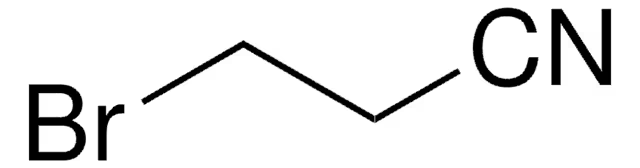
| Linear Formula | BrCH2CH2CN |
| Formula Weight | 133.98 |
| Physical Form | Clear Liquid at 20°C |
| Chemical Name or Material | 3-Bromopropionitrile |
| UN Number | 3276 |
| Molecular Weight | 133.97 g/mol |
| SMILES String | BrCCC#N |
| Refractive Index | n20/D 1.481 (lit.) |
| Assay | ≥98.0% (GC) |
| CAS Number | 2417-90-5 |
| EC Number | 219-332-4 |
| Empirical Formula | C3H4BrN |
| NACRES | NA.22 |
| PubChem Substance ID | 24846898 |
| UNSPSC Code | 12352100 |
| MDL Number | MFCD00001951 |
| InChI | 1S/C3H4BrN/c4-2-1-3-5/h1-2H2 |
| InChI Key | CQZIEDXCLQOOEH-UHFFFAOYSA-N |
| PubChem CID | 17020 |
| Beilstein/REAXYS Number | 1738565 |
| Quality Level | 200 |
| Functional Groups | Bromo, nitrile |
| Form | Liquid (clear liquid at 20°C) |
3-Bromopropionitrile is a haloalkyl nitrile with the formula C3H4BrN and a molecular weight of 133.97 g/mol. The bromine is on the carbon furthest from the cyano group, so it behaves as a primary alkyl bromide in SN2 reactions, while the nitrile is available for hydrolysis, reduction and cycloaddition. It is a different compound from 2-bromopropionitrile, in which the bromine is on the carbon next to the nitrile.
Under strong base, 3-bromopropionitrile loses HBr to form acrylonitrile, a flammable and toxic monomer, which is why it is kept away from bases during storage and why cyanoethylation reactions are run with controlled base stoichiometry.
The compound is used where a three-carbon chain with a terminal nitrile has to be attached to a nucleophile. Reactions with amines give N-(2-cyanoethyl) amines, with phenoxides give 3-aryloxypropionitriles and with thiols give 3-thiopropionitriles; reduction of the nitrile then provides 3-aminopropyl ethers, amines and sulfides. In polymer chemistry its activated C–Br bond serves as an ATRP initiating site for acrylonitrile.
The grade offered is at least 98.0% by GC. Ask for the Certificate of Analysis of the lot, and tell us if your process is sensitive to moisture or to trace acrylonitrile. Store locked up in a tightly closed container in a cool, well-ventilated area away from strong bases, strong oxidisers and strong acids. Use a fume hood, chemical-resistant gloves, eye and face protection and an ABEK-type respirator filter where vapour may be present. The product ships as UN 3276, nitriles, toxic, liquid, n.o.s.
Fatal if swallowed: do not eat, drink or smoke when using the product, work in a fume hood, keep it locked up and obtain medical attention immediately after any exposure.
No related products found.
It is used to attach a 2-cyanoethyl group to amines, phenols, thiols and carbanions, as an initiator for ATRP of acrylonitrile, and as a building block for 3-aminopropyl and β-alanine derivatives.
Yes. 3-Bromopropionitrile, 3-bromopropanenitrile, β-bromopropionitrile and 2-cyanoethyl bromide are the same compound, CAS 2417-90-5. 2-Bromopropionitrile is a different isomer.
The formula is C3H4BrN, the molecular weight is 133.97 g/mol and the boiling point is 76–78 °C at 10 mmHg. The density is 1.615 g/mL at 25 °C.
It is classified as fatal if swallowed (H300, Acute Tox. 2 Oral). Handle it only with engineering controls and protective equipment, and keep it locked up.
Strong bases remove HBr and form acrylonitrile, a flammable and toxic monomer. Keep the reagent away from bases in storage and control the base stoichiometry in cyanoethylation reactions.
Store it locked up in a tightly closed container in a cool, ventilated area, away from bases, oxidisers and acids. It ships as UN 3276, nitriles, toxic, liquid, n.o.s.
Yes. A Certificate of Analysis and Safety Data Sheet accompany each lot of SKU S2432, which is supplied to customers who can meet its handling requirements.Yes. A Certificate of Analysis and Safety Data Sheet accompany each lot of SKU S2432, which is supplied to customers who can meet its handling requirements.