

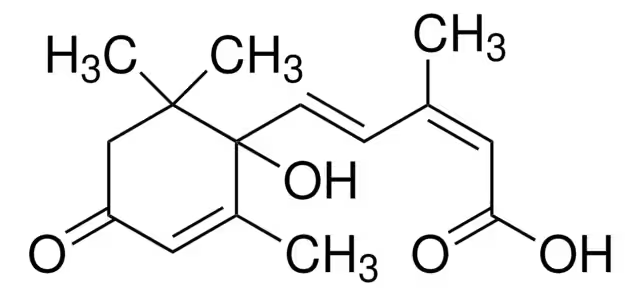
| Melting Point | 186–188 °C (lit.) |
| Physical Form | Powder |
| Molecular Weight | 264.32 g/mol |
| SMILES String | CC(\C=C\C1(O)C(C)=CC(=O)CC1(C)C)=C\C(O)=O |
| Assay | 98% |
| CAS Number | 14375-45-2 |
| Empirical Formula | C₁₅H₂₀O₄ |
| Recommended Storage Temperature | 2–8 °C |
| Key Functional Groups | Carboxylic acid, hydroxyl, ketone |
| NACRES | NA.22 |
| PubChem Substance ID | 24888569 |
| UNSPSC Code | 12352100 |
| MDL Number | MFCD00075619 |
| Quality Segment | 100 |
| InChI | 1S/C15H20O4/c1-10(7-13(17)18)5-6-15(19)11(2)8-12(16)9-14(15,3)4/h5-8,19H,9H2,1-4H3,(H,17,18)/b6-5+,10-7- |
| InChI Key | JLIDBLDQVAYHNE-LXGGSRJLSA-N |
| 5375199 |
Abscisic acid is best known as a plant stress hormone — it is the natural signal that helps plants regulate seed dormancy, stomatal closure, and their response to drought and other environmental stress, which is why it also carries the older name “Dormin.” The material supplied here is a synthetically produced version of the compound built to match the naturally occurring 2-cis,4-trans (2Z,4E) geometry, giving researchers a consistent, lab-ready supply without relying on plant extraction.
Structurally, the molecule combines a cyclohexenone ring with a conjugated dienoic acid side chain, giving it a carboxylic acid, a ketone, and a hydroxyl group all in the same framework (C₁₅H₂₀O₄, MW 264.32). That mix of functional groups is what makes it useful well beyond plant physiology — it also gives synthetic chemists a rigid, chiral scaffold that behaves predictably in downstream reactions.
In the synthesis lab, chemists most often reach for this compound as a raw starting material or, together with its derivatives, as a chiral auxiliary in asymmetric synthesis — using it as a temporary, removable chiral control element that biases a reaction toward one specific stereochemical outcome. It is also used as an analytical reference standard, including in chiral HPLC methods designed to resolve and quantify abscisic acid isomers.
Beyond synthesis, it turns up frequently in academic literature as the target analyte or reference compound in studies looking at biological extracts — for example, work on endophytic fungal extracts screened for cytotoxic or antidiabetic activity, enzyme-inhibition studies involving ABA derivatives, and metabolic research examining how small amounts of abscisic acid in fruit extracts influence glucose tolerance. Sarchem Labs supplies this material for these kinds of synthetic and analytical research applications, not as a bulk industrial commodity.
Naturally occurring abscisic acid in plants exists predominantly as a single enantiomer in the 2-cis,4-trans (S)-configuration. Because chemical synthesis does not automatically favor one mirror-image form over the other, commercially synthesized material is commonly supplied as the racemic (+/-) mixture, even while retaining the natural cis/trans double-bond geometry that defines this product.
No related products found.
It is primarily used as a synthetic intermediate and as a chiral auxiliary in asymmetric organic synthesis, where its rigid ring structure helps control the stereochemistry of a reaction. It also serves as an analytical reference standard in chiral HPLC methods.
Yes — this product is manufactured synthetically to match the natural 2-cis,4-trans configuration of abscisic acid, the plant hormone involved in stress response and seed dormancy. It is generally supplied as a racemic mixture rather than the single enantiomer found in plants.
Sarchem recommends storing it refrigerated at 2–8 °C in a tightly closed container, in a location appropriate for Storage Class 11 (combustible solids).
Standard recommended PPE includes chemical safety eyeshields or goggles, protective gloves, and an N95-type particulate respirator to avoid inhaling fine powder.
No — 2-cis,4-trans-abscisic acid is not an industrial polymer chain extender. It is a plant-hormone-related research chemical used in organic synthesis (as an intermediate and chiral auxiliary) and in analytical/biomedical research, not in polyester or polyurethane production.


